The Thar Desert does not look the same from a luxury Swiss tent at Sam Sand Dunes as it does from a basic cot in Khuri village, and the price difference between the two can be anywhere from ₹1,500 to ₹18,000 a night. Both can be worth it. Neither automatically is. What matters is knowing what the booking actually covers before the jeep drops you off forty kilometres from the nearest hotel.
Two Locations, Two Experiences
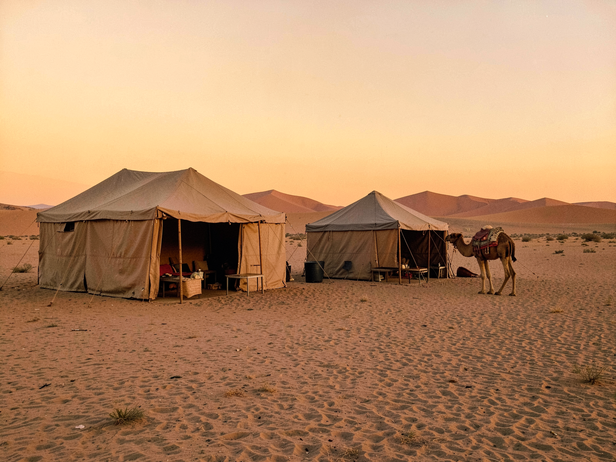
![Rajasthan Desert Camp Sunset]()
Rajasthan Desert Camp Sunset
Image credit : AI
Tranquil Rajasthan desert camp at golden hour. Experience a peaceful overnight stay at Sam Sand Dunes.
Sam Sand Dunes, roughly 42 kilometres west of Jaisalmer on the road toward the Pakistan border, is where most operators cluster. The dunes here are higher and more dramatic, the sunset crowd is larger, and the camps range from budget rows of fabric tents to sprawling setups with private attached bathrooms, generator power, and folk music stages. If the photograph in your head has a camel silhouette against an orange sky and a cold beer waiting in the tent, Sam is where that photograph is taken.
Khuri, about 48 kilometres south of Jaisalmer, runs quieter. The dunes are gentler, the operators are smaller, and several are family-run guesthouses that added desert camping as an extension of their rooms. The village itself, mud-and-mirror architecture, a handful of families, a school, is part of what you see. Khuri suits travellers who want the silence more than the spectacle. It is also where you are more likely to negotiate a genuinely local meal cooked by the family whose land you are sleeping on.
What a Standard Package Actually Includes
Most camps advertise a package, and most packages are built around the same skeleton: tent accommodation, dinner, breakfast, a camel ride, and cultural entertainment in the evening. The gaps are in the details.
Tent quality varies more than any other element. A deluxe tent at a mid-range Sam camp typically means a double bed with a proper mattress, an attached bathroom with a flush toilet and running water, and a small veranda. A standard tent at the same camp means a cot, a shared bathroom block, and a fan if the generator runs. Ask which category your booking falls into and ask for a photograph, not a brochure image.
The camel ride is almost always one ride of twenty to forty minutes, usually at sunset. This is enough to feel the rhythm of the animal and watch the light change on the dunes. It is not a long desert crossing. If you want more time on a camel, that is usually available for an additional fee, typically ₹300 to ₹600 per hour depending on the camp and the season.
Dinner at a reputable camp is a buffet of dal, sabzi, bajra roti, rice, and a dessert, often kheer or gulab jamun. Some higher-end camps add a live tandoor and a wider spread. Ask whether the food is prepared on-site or brought in from Jaisalmer town. Brought-in food is not necessarily worse, but it tells you something about the operation.
Cultural entertainment typically means a Kalbeliya or Manganiyar performance, folk musicians and dancers from communities whose traditions are tied to Rajasthan's desert belt. At the better camps this is a genuine performance by working artists. At the cheaper ones it can be a single musician with a recorded backing track. The difference is audible within thirty seconds.
Stargazing: What the Thar Sky Actually Delivers
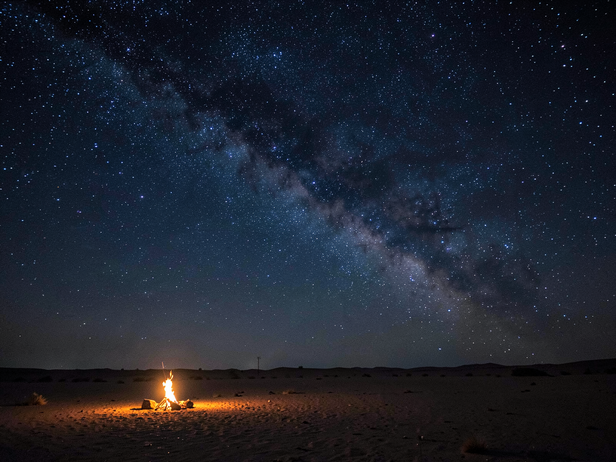
![Desert Night Sky Arch]()
Desert Night Sky Arch
Image credit : AI
Experience the magic of a desert camp in Rajasthan, with the Milky Way stretching across the clear night sky.
The Thar is one of the few places in India where you can stand outside at midnight and see the Milky Way without a telescope. The nearest significant light pollution is Jaisalmer town, and on a clear night with no moon, the sky at Sam or Khuri is genuinely dark. Scorpius is visible from the southern horizon in summer. Orion dominates winter nights. The Andromeda Galaxy is naked-eye visible on the best nights.
The conditions that matter: no full moon, no cloud cover, and a camp that turns its generator off by 11 pm. Ask the operator specifically whether lights-out is part of the schedule. Some camps run generators and floodlights through the night for guests who want air conditioning, which wrecks the sky for everyone else. If stargazing is a priority, book a camp that explicitly offers it and confirm the lights policy.
No camp in the Jaisalmer area currently offers guided astrophotography sessions with proper telescopes as a standard inclusion. A few operators advertise this; what they mean is a camp staff member with a consumer-grade telescope and a phone tripod. Manage expectations accordingly.
Questions to Ask Before Booking
The booking conversation is where most disappointments are preventable. These are the questions worth asking directly, by phone or WhatsApp, before paying a deposit.
Is the camp on private land or on government-notified dunes? Camps operating without proper permits have been periodically cleared by the Rajasthan government, particularly around Sam. A legitimate operator will answer this without hesitation.
What is the distance from the camp to the nearest dune crest? Some camps advertise a dune location but sit in a flat sandy area with a dune visible in the distance. The walk to the actual dune matters if you are planning a sunrise climb.
Is the price per person or per tent? This is the most common source of billing confusion. Clarify whether the quoted rate includes both people in a couple or is per head, and whether children are charged separately.
What is the cancellation policy? Jaisalmer camps in November and December are in peak season. A camp that will not refund a deposit for a cancellation made two weeks out is not behaving unusually, but you should know before booking. Many reputable operators allow date changes without penalty if given enough notice.
Does the package include jeep transfer from Jaisalmer? Some do. Many do not. A shared jeep from Jaisalmer to Sam costs roughly ₹200 to ₹300 per person; a private cab runs ₹800 to ₹1,200 one way. If the camp does not arrange transport, factor this into the total cost.
What to Bring and What to Leave Behind
November nights in the Thar drop to 8 to 12 degrees Celsius. The days are warm and the evenings cool fast once the sun drops. A fleece and a light down jacket are not optional in late November; they are the difference between enjoying the fire and retreating to the tent by 9 pm.
Bring a torch with a red-light mode if stargazing matters to you. Red light preserves night vision; a white torch beam from a neighbouring tent will reset your dark adaptation completely. A small power bank is useful since charging points in standard tents are limited to one or two sockets.
Leave behind any expectation of reliable mobile signal. Airtel and Jio both have coverage gaps at Sam and Khuri. This is not a complaint, it is the point. The Thar at night, with no signal and no ambient light, is one of the few places in India that still feels genuinely far away. The questions worth asking are all the ones you ask before you go.