Dev Deepavali is not Diwali with a longer name. It falls on Kartik Purnima, the full moon night fifteen days after Diwali, and on that evening the ghats of Varanasi are dressed in somewhere between eight and twelve lakh diyas, the count varies by year and by who is doing the counting. The Ganga Seva Nidhi, which organises the main aarti and lamp-lighting, coordinates the placement from Rajghat in the north to Assi Ghat in the south, a riverfront stretch of roughly six and a half kilometres. What you see depends almost entirely on where you are standing when the lamps go down.
The Ghat-by-Ghat Logic
Dashashwamedh Ghat is the axis. The main Ganga Mahaaarti happens here every evening, but on Dev Deepavali it is amplified, more priests, more lamps, a larger crowd. If you want to be inside the ritual, this is the ghat. The tradeoff is that by 5 pm the steps are so packed that movement stops. You arrive early and you stay put. The view is close and loud and genuinely overwhelming, which is either the point or a problem depending on what you came for.
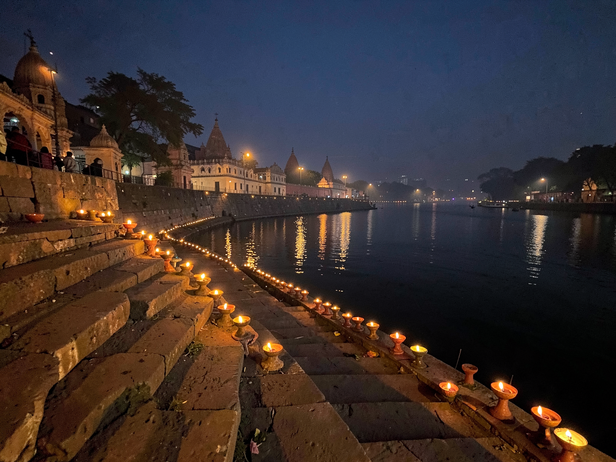
Manikarnika Ghat, a few minutes north on foot, is the cremation ghat. It burns every night of the year. On Dev Deepavali the diyas are placed along its upper steps and walls, and the contrast, funeral pyres below, lamps above, the full moon on the river, is unlike anything else on the ghats. It is not a comfortable scene and it is not meant to be. Locals treat it as sacred ground, not spectacle. If you go, go quietly and do not photograph the pyres.
Assi Ghat at the southern end draws a different crowd: students from Banaras Hindu University, sadhus who live nearby, and travellers who have been in the city long enough to have a favourite tea stall. The lamp-lighting here is less orchestrated and more neighbourhood. The aarti is smaller. The steps are accessible well past sunset. If you want to sit close to the water and actually watch people place diyas without being carried along by a crowd, Assi gives you that.
Panchganga Ghat, north of Dashashwamedh, sits below the Alamgir Mosque and is one of the five sacred confluences. It is less visited on Dev Deepavali than the central ghats, which means you can find a position on the steps without arriving two hours early. The lamp rows here tend to be denser than at Assi because the steps are narrower and the diyas stack up the walls.
![Varanasi Ghats Aglow]()
Varanasi Ghats Aglow
Image credit : AI
I witness the magical glow of Dev Deepavali Varanasi, with countless diyas lighting the ghats.
What a Boat Actually Gets You
Every guesthouse in Varanasi will sell you a boat for Dev Deepavali night. The price on a shared boat runs between three hundred and six hundred rupees per person depending on how close to the festival date you book and how hard you negotiate; a private boat for two to four people runs between fifteen hundred and three thousand rupees for two to three hours. Book the day before at the latest, on the day itself, prices double and availability collapses.
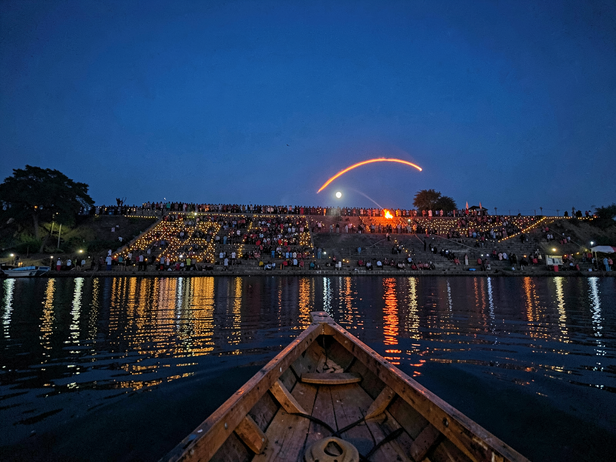
A boat gives you the panorama. You see the entire lit ghat face at once, the reflection doubling the lamps on the water, the aarti fire arcing over the crowd at Dashashwamedh. That image, the one on every travel piece about Dev Deepavali, is only visible from the river. You cannot get it from the steps.
What a boat does not give you is the smell of wax and marigold, the sound of the conch at close range, the heat of the lamps near your feet, or any sense of being inside the event rather than watching it. The boat is the photograph. The ghat is the experience. Most people who have done both once will tell you to do the ghat first and the boat on a quieter evening, but if you have one night in Varanasi and the panorama is what brought you here, the boat is the honest choice.
One practical note: boats move. Your boatman will row you slowly along the full ghat length, which means you get a changing view rather than one fixed position. If you want to photograph the aarti at Dashashwamedh from the water, tell the boatman to hold position opposite that ghat for at least twenty minutes. Otherwise you will drift past it mid-ceremony.
Getting There and Where to Sleep
Varanasi's nearest airport is Lal Bahadur Shastri International at Babatpur, about twenty-five kilometres from the ghats. Flights from Delhi take about an hour and a half; from Mumbai, two and a half hours. Trains from Delhi to Varanasi Junction or Manduadih take between eight and thirteen hours depending on the service. Book either at least six weeks before Kartik Purnima, the festival draws visitors from across Uttar Pradesh and beyond, and both flights and trains fill early.
The guesthouses that sit directly on the ghats, particularly the lanes behind Dashashwamedh and Assi, book out months in advance for Dev Deepavali. If you are arriving within three weeks of the festival and have not yet booked, look at hotels in the Godowlia or Sigra neighbourhoods, ten to fifteen minutes by auto-rickshaw from the ghats. Budget guesthouses on the ghats run between eight hundred and fifteen hundred rupees a night in the weeks around Kartik Purnima; mid-range hotels off the ghats run between two thousand and four thousand. Prices in both categories spike sharply in the final week.
Getting to the ghats on the night itself: the lanes leading down from Godowlia are closed to vehicles from early afternoon. Walk. Allow forty-five minutes from Godowlia on foot if the crowd is moving; allow ninety minutes if it is not.
![River of Lamps at Dusk]()
River of Lamps at Dusk
Image credit : AI
My boat glides on the dark river, witnessing the spectacular Dev Deepavali Varanasi with lamps and a fiery aarti.
The Moon and the Timing
Kartik Purnima means the full moon of the month of Kartik in the Hindu lunar calendar. In 2026, that falls on the night of 23 November. The lamp-lighting on the ghats begins roughly at sunset, which in Varanasi in late November is around 5:20 pm. The main aarti at Dashashwamedh starts between 6 and 6:30 pm and runs for forty-five minutes to an hour.
The full moon rises in the east as the sun sets in the west, which means that by 7 pm you have the lamps on the ghats, the aarti fire, and the moon over the river simultaneously. That window, roughly 6:30 to 8 pm, is when every photograph of Dev Deepavali is taken. It is also when the crowd is at its tightest. If you are on the steps, be in position by 5:30 pm. If you are on a boat, be on the water by 6 pm.
After 9 pm the crowd thins, the lamps burn lower, and the ghats return to something closer to their ordinary night self. That hour, 9 to 10 pm, is when the city is still lit and the steps are walkable again. It is a different kind of beautiful, and you will have it almost to yourself.