Tulsi Vivah is not a festival that announces itself with processions or fireworks. It arrives quietly, on the eleventh or twelfth day of Kartik Shukla Paksha, and in the right places it turns a temple courtyard or a ghat into something a traveller can stand inside and actually feel. The ceremony marks the symbolic marriage of the tulsi plant to Shaligram, a form of Vishnu, and it signals that the auspicious wedding season has opened. In most homes it is private. In a handful of towns, it is public enough to attend with care and some preparation.
Vrindavan: The Town Where Every Courtyard Has a Ceremony
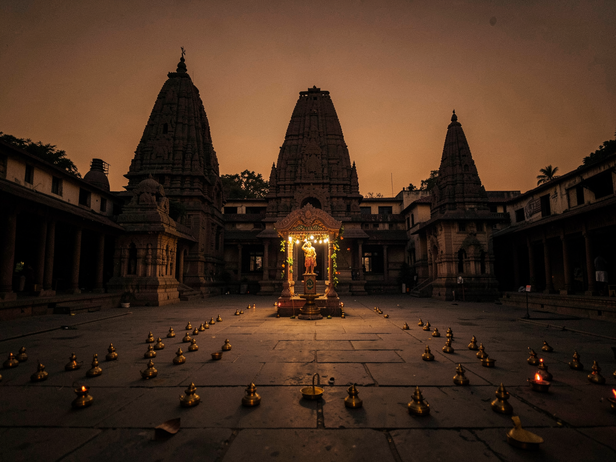
Vrindavan is the most reliable place in north India to witness Tulsi Vivah performed at scale. The town's temples do not restrict the ritual to a single space. The Banke Bihari Mandir, the Radha Raman Mandir, and the smaller ashram courtyards along the Yamuna parikrama path all conduct their own ceremonies on Kartik Ekadashi or Dwadashi, and the timing staggers across the day and into the evening. The Radha Raman Mandir is particularly worth noting: it is one of the few temples in Vrindavan that still follows the Gaudiya Vaishnava calendar with strict adherence, and the tulsi plant there is treated as a central deity rather than a peripheral ritual object. Arrive before sunset. The deepdan, the offering of lamps to the river and the tulsi, begins at dusk and is the visual heart of the ceremony. Dress conservatively, remove footwear before the courtyard threshold, and do not photograph the inner sanctum without permission. The outer courtyard is generally open.
![Temple Courtyard at Dusk]()
Temple Courtyard at Dusk
Image credit : AI
I photograph a tranquil temple courtyard at dusk, featuring a lit Tulsi Vrindavan, perfect for experiencing Kartik festival temples.
Varanasi: Ghats and the Riverside Mandap
Varanasi conducts Tulsi Vivah differently from temple towns further west. Here the ceremony attaches itself to the Kartik Purnima preparations along the ghats, and several of the larger ghat temples, particularly around Tulsi Ghat and Assi Ghat, set up temporary mandaps for the marriage ritual. Tulsi Ghat takes its name from the poet-saint Tulsidas, who is said to have lived there, and the connection gives the ceremony an added layer of local observance. The Sankat Mochan Hanuman Mandir, a short walk from Assi Ghat, also conducts a public ceremony that draws neighbourhood families rather than pilgrims from outside, which means the atmosphere is domestic and unhurried rather than crowded. Getting there from the ghats on foot takes about fifteen minutes. The ceremony typically begins after the evening Ganga aarti at Dashashwamedh Ghat, so a traveller can attend both in a single evening if they are willing to walk.
Nathdwara and the Pushkar Circuit in Rajasthan
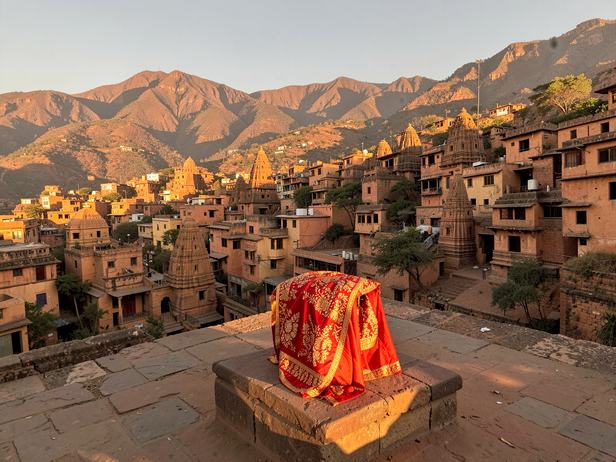
Nathdwara, in the Aravalli hills of Rajasthan, is the seat of the Shrinathji temple and one of the principal Vaishnava pilgrimage sites in the country. The temple follows its own liturgical calendar with precision, and Tulsi Vivah here is conducted as part of a longer Kartik observance that includes the tulsi plant being dressed in bridal clothes and the Shaligram shila being brought out in formal procession. The ceremony is open to devotees in the outer courtyard. Nathdwara is about forty-eight kilometres from Udaipur by road, and the drive through the hills takes just over an hour. Pushkar, further north, conducts smaller household ceremonies that spill into the lanes around the Brahma temple during Kartik. The town's ghats are lit with diyas on the same evenings, and the effect is close enough to a public Tulsi Vivah that the distinction becomes academic for a traveller passing through during the fair season.
![Golden Hour Rajasthan Hill Town]()
Golden Hour Rajasthan Hill Town
Image credit : AI
I photograph a serene Rajasthan hill town at golden hour, featuring a decorated tulsi vrindavan. This scene evokes the spirit of Tulsi Vivah travel India.
Maharashtra: Pandharpur and the Wari Tradition
Tulsi Vivah in Maharashtra carries a distinct flavour because the Varkari tradition, the devotional movement centred on Vitthal of Pandharpur, treats the ceremony as a community event rather than a household one. In Pandharpur, the temple town on the Bhima river, the ceremony is conducted in the temple precincts and in the open space around the Chandrabhaga ghat. The winding lanes between the main temple and the river fill with families carrying decorated tulsi vrindavans, the small raised platforms on which the plant is kept. A traveller who arrives in Pandharpur during Kartik Shukla Ekadashi will find the ceremony in progress in multiple locations simultaneously. The town is approximately seventy-five kilometres from Solapur, which has rail connections to Pune and Mumbai. Accommodation in Pandharpur is basic and books out during Kartik; Solapur is a more comfortable base.
Practical Notes for Attending
The date of Tulsi Vivah shifts each year with the lunar calendar. In 2026, Kartik Ekadashi falls in mid-November. Confirm the exact date against a current Panchang before booking travel, because a one-day error means missing the ceremony entirely. In all four locations, the ceremony is most visible in the two hours around sunset and into the first hour of darkness. Mornings are quieter and better for visiting the temples themselves. Carry a dupatta or shawl regardless of gender; most temple courtyards require head covering during the ceremony. Offerings of tulsi leaves, sugar cane, and amla are sold at the entrance to most temple towns and are an appropriate way to participate rather than observe from the outside.