Chhath Puja does not announce itself the way most Delhi festivals do. There are no lights strung across markets weeks in advance, no public address systems warming up at noon. It arrives through the city's eastern and northern neighbourhoods in the form of bamboo baskets being woven, sugarcane stalks being bundled, and the particular smell of thekua, wheat and jaggery fried in ghee, drifting from ground-floor kitchens. By the time the ghats open, the preparation has already been running for four days.
Which Ghats Actually Open
The Delhi government designates official Chhath ghats along the Yamuna each year, and the list shifts. Consistent across most years: Kalindi Kunj, Geeta Colony, Sonia Vihar, Wazirabad, and the stretch near the ITO floodplain. Kashmere Gate and Raj Ghat-adjacent banks also see significant gatherings. The floodplain ghats, essentially the Yamuna's sandy banks between the bridges, hold the largest crowds because they have the most open space. Geeta Colony ghat draws heavily from the trans-Yamuna neighbourhoods of Shahdara and Patparganj, where UP and Bihar migrant communities are concentrated. Kalindi Kunj pulls from Okhla and the southern belt. Neither is a tourist ghat. Both are community events that happen to be visible to anyone who walks in.
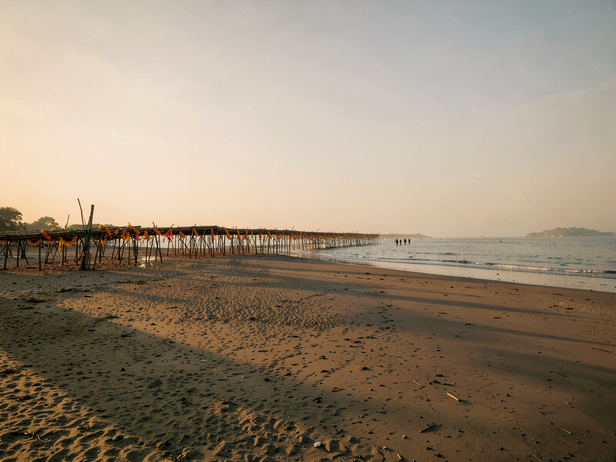
![Golden Hour Floodplain Ghat]()
Golden Hour Floodplain Ghat
Image credit : AI
I witness the serene beauty of a Delhi Chhath ghat during golden hour, with distant devotees approaching.
The Water Question, Honestly
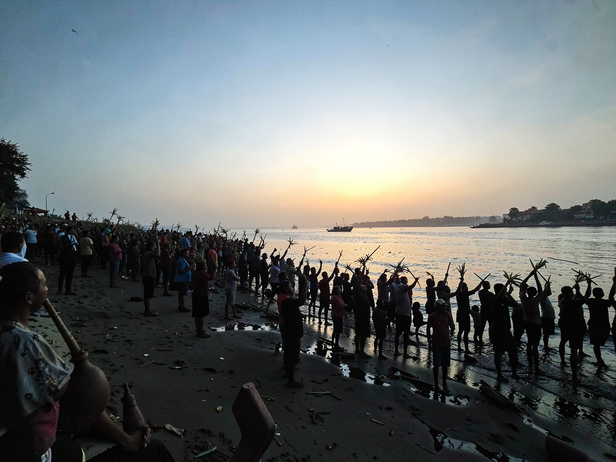
The Yamuna at Delhi is among the most polluted stretches of any river in the country. The Central Pollution Control Board has consistently recorded dissolved oxygen levels near zero and biochemical oxygen demand many times above safe limits in the Delhi segment, particularly between Wazirabad and Okhla, exactly the stretch where most Chhath ghats sit. Devotees wade in regardless, and have for generations. This is not ignorance. For most families observing Chhath, the ritual standing in the river is non-negotiable, and the faith that frames it is not diminished by a water quality report. The honest position for a visitor is to understand both things at once: the river is genuinely compromised, and the act of standing in it carries meaning that a pollution index cannot measure. If you are not observing the fast yourself, you will not be wading in. Watch from the bank. The image of a thousand people in saffron and red, holding arghya vessels toward a sun that is either just rising or just setting over the Delhi skyline, is one the city does not manufacture for anyone.
The Crowd Hours and How They Move
Chhath runs across four days, but the ghat action concentrates on two: Sandhya Arghya on the third evening, when offerings are made to the setting sun, and Usha Arghya on the fourth morning, when they are made to the rising sun. Sandhya Arghya draws the larger crowd, families arrive from early afternoon and the banks are at maximum density from roughly two hours before sunset until an hour after. At Kalindi Kunj and Geeta Colony this means the access roads and parking areas are functionally closed by 2 pm. The Metro is the only reliable way in: Kalindi Kunj station on the Violet Line deposits you within walking distance, and the Delhi Metro Rail Corporation typically runs additional services on both Arghya days. Usha Arghya is the quieter of the two mornings only by comparison. Devotees who fasted through the previous day and night are already at the ghat before 4 am. The crowd is intense but more contained, and the light, a grey pre-dawn that turns gold in minutes, is the better photographic moment if that is what you are there for. Leave before 7 am or plan to stay until the roads clear, which takes until mid-morning.
![Sunrise Devotion at River Ghat]()
Sunrise Devotion at River Ghat
Image credit : AI
Witnessing the dawn's first light at the Yamuna Chhath 2026 ghats, a moment of quiet devotion.
Getting There, Getting Out
For Sandhya Arghya, aim to be at your chosen ghat by noon if you want a position with a clear sightline to the water. This is not an exaggeration. The floodplain fills from the edges inward, and by 1 pm the front rows belong entirely to observing families. Visitors who arrive at 4 pm find themselves at the back of a crowd that extends several hundred metres from the waterline. Auto-rickshaws and cabs stop working the approach roads well before sunset because the lanes are taken over by foot traffic and police barricades. Wear footwear you can remove easily, the sand near the water is wet and the approach paths are unpredictable. Carry water. There is food being sold at every ghat perimeter, primarily thekua, sugarcane juice, and seasonal fruit, and buying from the vendors there is both practical and appropriate. For Usha Arghya, leave home before 3:30 am. The Metro runs from 4 am on these mornings; check the DMRC schedule for the specific year because it varies. The roads are clear at that hour, and a cab or auto will reach the ghat without obstruction. The return, from 6:30 am onward, is congested again.
What You Are Watching
Chhath is not a spectator festival in its structure, it is a family fast observed by a single devotee, usually a woman, on behalf of her household. The vratini stands in water for extended periods, holds offerings toward the sun, and receives nothing in return except the completion of the vow. There is no priest conducting the ritual, no amplified prayer, no stage. The sound at the ghat is collective and low: Chhath geet sung by families, the specific folk songs of the Bhojpuri and Maithili traditions that travel with the communities who observe this fast. If you are there as a visitor, the appropriate mode is quiet presence. Do not photograph individuals without a gesture of acknowledgment. Do not wade into the water area where families are standing. The ghat has a front that belongs to the observing families and a back that is open to everyone. Stay in the back until you understand which is which. What you will see from there is already extraordinary: a river that the city has largely turned its back on, briefly and completely reclaimed.