The two countries share a border only on paper; in practice, most travellers connect through Thailand, crossing into Laos at Huay Xai after flying into Bangkok or Chiang Mai, or looping back through Phnom Penh to catch a flight north. The smarter sequence is Cambodia first, Laos second, because the slow boat down the Mekong from Huay Xai to Luang Prabang runs on a fixed two-day schedule and works beautifully as a final act, you arrive in Laos already winding down.
Angkor: Which Gate, Which Hour, Which Day
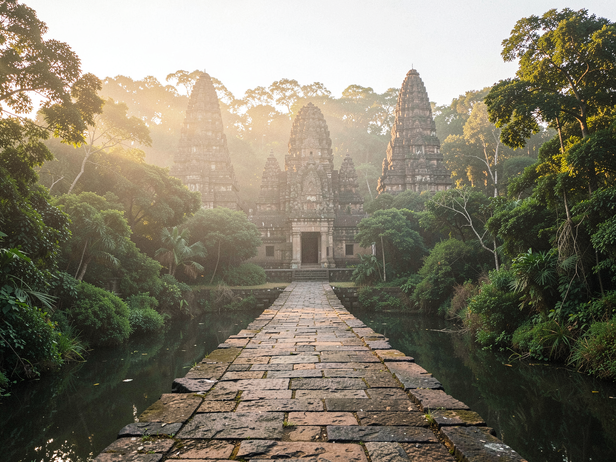
Angkor Wat faces west, which means sunrise photographers crowd the main causeway reflection pool from 5 a.m. every single morning. If that image is not the reason you came, enter from the east gate instead, where the light at 6 a.m. is warm and the paths are nearly empty. The temple complex opens at 5 a.m. for sunrise ticket holders; the standard day pass activates at 7:30 a.m. A one-day pass costs USD 37, three days USD 62, seven days USD 72. Buy it at the official Angkor Enterprise ticket centre the evening before, the queue there at 5 a.m. is longer than the one at the east gate.
Ta Prohm, the tree-root temple, draws its biggest crowds between 9 a.m. and 11 a.m. Arrive before 8 a.m. or after 3 p.m. Bayon, with its 216 carved faces, is best in the flat light of mid-morning when the stone reads clearly; the faces disappear into their own shadow at golden hour despite what Instagram suggests. Preah Khan is genuinely undervisited and rewards an afternoon when everyone else has retreated to their guesthouse for the heat. Build in a rest day in Siem Reap, the temples cover 400 square kilometres and two days of walking in 35-degree heat without a buffer day is a reliable way to arrive in Laos exhausted.
![Misty Jungle Temple Dawn]()
Misty Jungle Temple Dawn
Image credit : AI
Exploring ancient temples during my Cambodia Laos trip itinerary, this view took my breath away.
Phnom Penh to the Laos Border: The Realistic Options
There is no direct overland crossing between Cambodia and Laos that most travellers use without significant difficulty. The Dom Kralor-Nong Nok Khiene crossing in northeastern Cambodia exists, but the roads approaching it from the Cambodian side are rough and public transport is infrequent. The standard route is Phnom Penh or Siem Reap to Bangkok by bus or flight, then Chiang Mai or Chiang Rai to Chiang Khong, then across the Mekong bridge to Huay Xai in Laos. Bangkok to Chiang Khong by overnight bus takes roughly 12 hours; the Chiang Rai to Chiang Khong leg by minivan is about two hours. The Friendship Bridge crossing at Chiang Khong-Huay Xai is straightforward, a short shuttle bus takes you across, Laos visa on arrival is available for most nationalities at USD 30 to USD 42 depending on passport, and the process takes 20 to 40 minutes outside peak hours.
If you are flying, Bangkok to Luang Prabang direct takes roughly 1 hour 45 minutes. That skips the slow boat entirely, which is a legitimate choice when time is tight, but the Mekong journey is one of the few travel experiences in Southeast Asia that genuinely earns its reputation.
The Mekong Slow Boat: What It Actually Is
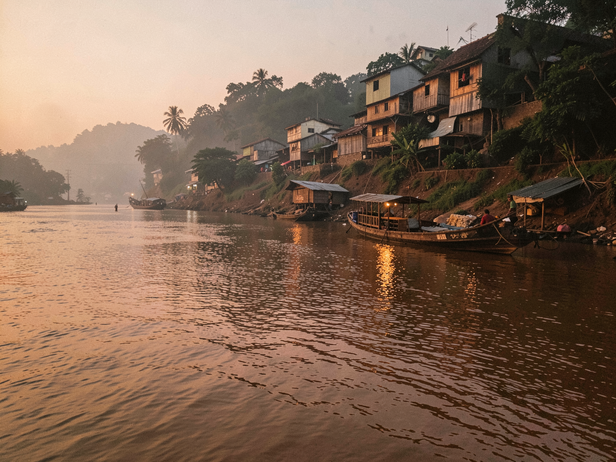
The slow boat from Huay Xai to Luang Prabang covers approximately 300 kilometres over two days, stopping overnight at the small town of Pak Beng. The boats are wooden, wide, and low, not luxury vessels. Seating is on wooden benches or basic chairs; most boats now have cushioned seats after years of traveller feedback, but confirm this when you buy your ticket in Huay Xai, because older hulls still run the route. Tickets cost roughly 250,000 to 350,000 Lao kip per leg (approximately USD 12 to USD 17 at current rates, though exchange rates shift). Buy at the boat pier in Huay Xai the morning of departure; the boats leave at 11 a.m. and boarding starts at 9 a.m. Arrive by 9:30 a.m. to claim a window seat.
Day one runs roughly six to seven hours to Pak Beng. Day two is five to six hours into Luang Prabang. Bring water, snacks, a book, and something warm, the river wind at speed drops the temperature considerably even in October. Pak Beng has basic guesthouses ranging from USD 5 to USD 20 a night; book nothing in advance, just walk off the boat and choose. The town exists almost entirely to house slow boat passengers overnight, so rooms are always available outside Chinese New Year and Lao New Year.
![Mekong River Dusk Scene]()
Mekong River Dusk Scene
Image credit : AI
I witness the Mekong slow boat at dusk, a scene from my Cambodia Laos trip itinerary.
Luang Prabang: What to Do With the Days That Remain
Luang Prabang is a UNESCO-listed town on a peninsula where the Nam Khan river meets the Mekong. The alms-giving ceremony, tak bat, happens every morning at around 5:30 a.m. along Sakkaline Road, monks in saffron walk in silence while residents offer sticky rice. Watch from a respectful distance, stand back from the procession, and do not use flash photography. The ceremony is a genuine daily practice, not a performance, and the tourist habit of pressing close with cameras has already caused the town's authorities to issue public requests for restraint.
Kuang Si Waterfall, 29 kilometres south of town, is the standard day trip. The turquoise tiered pools are real and the colour is real, it comes from the high calcium carbonate content of the water. Tuk-tuks from the night market to Kuang Si cost around 60,000 to 80,000 kip return per person for a shared ride. Go on a weekday morning and leave by 11 a.m. before the tour groups arrive from the cruise boats. Wat Xieng Thong, at the northern tip of the peninsula, is the finest temple in town, the rear wall mosaic of the tree of life is worth the 20,000 kip entry on its own.
Border Paperwork: The Actual Documents You Need
Cambodia e-visa is available online at evisa.gov.kh for USD 36 and processes in three business days. The visa on arrival at Phnom Penh and Siem Reap airports costs USD 30 for a tourist visa but requires a passport photo and USD 35 if you arrive on a weekend, the extra USD 5 is an unofficial overtime fee that is effectively standard practice. Carry printed copies of your e-visa; the scanners at land borders occasionally fail and a paper backup prevents a long argument.
Laos visa on arrival requires one passport photo, the visa fee in USD (exact change preferred, many border posts do not give change in USD), and a completed arrival card. The fee varies by nationality between USD 30 and USD 42; check the Lao embassy website for your specific passport before travel. The Huay Xai crossing is one of the more organised Laos land borders and the process is rarely longer than 45 minutes. Keep USD 1 to USD 2 in small bills for the Thai exit stamp booth at Chiang Khong, which charges a small processing fee outside regular hours, another informal but consistent cost.
Health insurance that covers evacuation is not optional in either country. Medical facilities outside Phnom Penh, Vientiane, and Luang Prabang are limited; the nearest hospital with reliable surgical capacity to Pak Beng is in Luang Prabang, several hours away by boat.
The trip works best over 14 to 18 days: four or five in Siem Reap, two in Phnom Penh, two travel days to reach Huay Xai, two on the slow boat, and five or six in Luang Prabang with day trips. Compress it below 12 days and the border transit days stop being part of the journey and start being the thing that eats the journey.