A stromatolite is a layered mound of fossilised algae. It is also, depending on which geologist you ask, among the oldest evidence of life on this planet. At Salkhan Fossil Park in Uttar Pradesh's Sonbhadra district, you can put your hand on one. The rock does not feel old. That is the first thing that surprises you.
Salkhan, Sonbhadra: Life Before Animals Existed
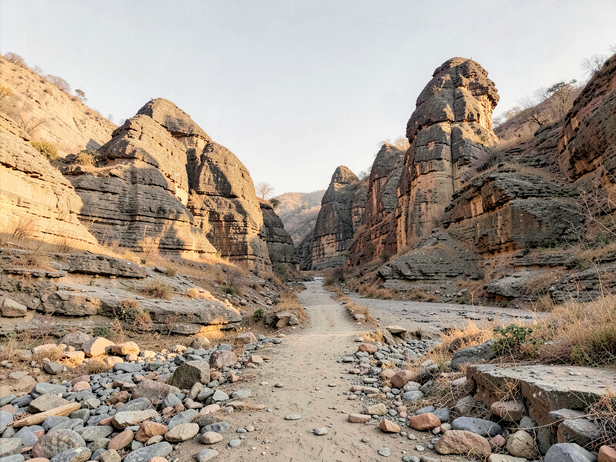
The Salkhan Fossil Park sits roughly 15 kilometres from Robertsganj, reached by road from Varanasi in about four hours. The fossils here are stromatolites, dome-shaped, column-shaped, and branching structures formed by cyanobacterial mats between 1,400 and 570 million years ago, during the Proterozoic eon. To be precise: these structures were laid down before complex animal life existed anywhere on Earth.
The park is managed by the Geological Survey of India, and the fossils are embedded in the actual rock face of the Son River gorge. There are no glass cases. You walk among them on a marked path, and the scale is domestic, knee-height, waist-height, which makes the age harder to process, not easier. A sign tells you the number. The number does not land. What lands is the texture under your fingers: smooth, layered, warm from the afternoon sun, indifferent.
The best time to visit is between October and February, when the gorge is dry and walkable. Summers are severe in Sonbhadra, and the monsoon makes the riverbed path impassable. Budget accommodation is available in Robertsganj; Varanasi is the nearest city with a full range of options. Entry to the park is nominal and managed on-site.
![Dry Gorge Rock Formations]()
Dry Gorge Rock Formations
Image credit : AI
I explore the geological heritage of Uttar Pradesh, marveling at ancient rock formations.
Saketi, Himachal Pradesh: The Shivalik Bestiary
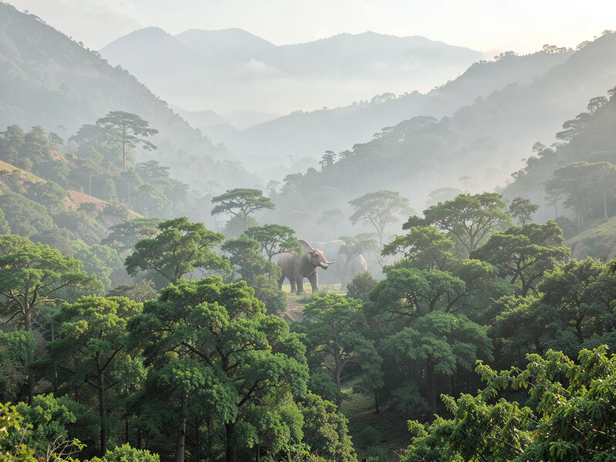
Saketi Fossil Park in Himachal Pradesh's Sirmaur district preserves a different order of deep time, more recent, and in some ways more unsettling, because the animals are recognisable. The Shivalik Hills yielded fossils of Sivatherium, a giraffe relative that stood nearly three metres at the shoulder, Stegodon, an extinct elephant ancestor, and Bramatherium, another giant that browsed these slopes somewhere between 12 and 2 million years ago, during the Miocene and Pliocene epochs.
The park displays life-size fibreglass reconstructions of these animals alongside the actual fossil beds from which they were recovered. The reconstructions are not subtle. Sivatherium beside a sal tree is a genuinely disorienting sight, not because it is strange, but because it is almost familiar. The proportions are close enough to living animals that your brain keeps trying to file it somewhere and failing.
Saketi is about 50 kilometres from Nahan, which connects to Chandigarh by road in roughly three hours. The park is run by the Himachal Pradesh forest department. October through March is the comfortable visiting window; the hills are green and accessible, and the light in the mornings is good for the outdoor exhibits. The fossil beds themselves are partially exposed and partially protected under covered structures.
Mandla, Madhya Pradesh: The Petrified Forest
The Dinosaur Fossil National Park near Ghughua village in Madhya Pradesh's Mandla district is the one that most people have heard of without quite knowing where it is. The fossils here are not bones. They are trees, or rather, the silica-replaced remains of trees from the Late Cretaceous, roughly 65 to 100 million years ago, when this part of central India was a different kind of landscape entirely, subtropical and low-lying, crossed by rivers that are now the Narmada's tributaries.
The petrified logs lie where they fell, or close to it. Some are two metres in diameter. The wood grain is visible. The rings are visible. You can see, in cross-section, what the interior of a tree looked like when dinosaurs moved through the same forest. The Geological Survey of India has identified several dinosaur egg nesting sites in the surrounding region, and some of the egg fossils are displayed in the small on-site museum.
Mandla town is the base. Jabalpur, roughly 100 kilometres away, is the nearest city with a rail connection and full accommodation. The drive from Jabalpur to Ghughua takes about two and a half hours on NH30 and state roads. October to March is the visiting season; the Narmada valley in summer is not a place to be on foot in the afternoon. The site entry fee is low, the museum is small but careful, and the walk among the logs takes between one and two hours depending on how long you stand.
![Prehistoric Giant in Shivalik Mist]()
Prehistoric Giant in Shivalik Mist
Image credit : AI
I discover a prehistoric marvel within the Shivalik Hills, a testament to India's geological heritage.
What These Three Places Share, and What They Don't
Salkhan, Saketi, and Mandla are not interchangeable. Salkhan is geology at its most austere, no reconstructions, no museum drama, just rock and a number you cannot hold. Saketi gives you the animals back, almost, in a form your body can read. Mandla gives you the forest: the specific, domestic fact of wood grain and tree rings from a world that ended before humans were a possibility.
All three are under-visited relative to what they contain. None has the infrastructure of a national park built for tourism. Roads are state roads. Signage is improving but incomplete. This is not a complaint, it is the condition that makes the experience what it is. You are not being managed through an exhibit. You are standing in a place where the earth kept a record, and someone cleared a path to it.
The Geological Survey of India maintains all three under its national geo-heritage monument framework. If you are travelling with children, Saketi's reconstructions are the most immediately legible. If you want the thing itself, unmediated, Salkhan is the one. Mandla is for anyone who needs the scale made specific: not millions of years as an abstraction, but a tree, lying on its side, that was already ancient when the Cretaceous ended.