The forest that greets you in the first week of October at Kanha or Tadoba is not the same forest that closed in June. Four months of rain have done something to it. The grass stands shoulder-high in the meadows, the waterholes are full and ringed with fresh pugmarks, and the animals, unobserved for months, move with a looseness that the busy winter season slowly trains out of them.
Which Parks Open First
Most of Madhya Pradesh's tiger reserves, Kanha, Bandhavgarh, Pench, and Satpura, reopen on 1 October, though the precise date shifts by a day or two depending on the forest department's assessment of road conditions that year. Tadoba-Andhari in Maharashtra follows on roughly the same schedule. Corbett's Dhikala zone, which sits inside the riverbed and floods badly, typically stays shut until 15 November; its buffer zones open earlier. Ranthambore in Rajasthan reopens on 1 October but the park's famous lakes, Padam Talao, Malik Talao, take a few weeks to settle after the rains, and sightings in October are genuinely unpredictable. Kaziranga in Assam, which floods dramatically every monsoon, reopens in stages from late October, with some ranges accessible before others depending on how the Brahmaputra receded that year. Nagarhole and Bandipur in Karnataka reopen in October as well, though the southern parks run on a slightly different seasonal logic, their dry season is harsher than their monsoon, and the reopening there feels less dramatic than in central India.
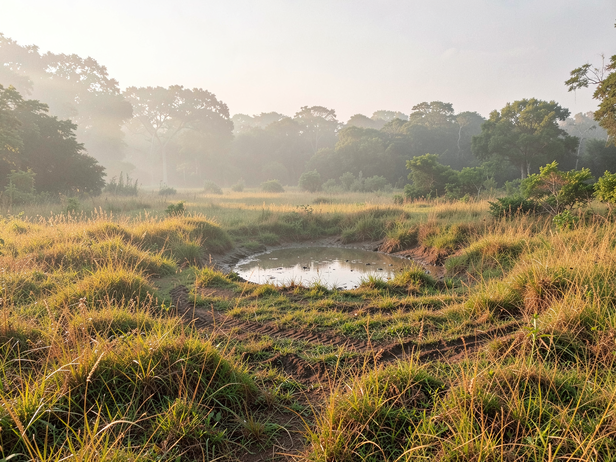
![Misty Indian Jungle Meadow]()
Misty Indian Jungle Meadow
Image credit : AI
I observe a serene Indian jungle meadow at dawn, a perfect scene for the India national park safari season.
What the Landscape Looks Like in the Early Weeks
The first thing most visitors notice is how little they can see. This sounds counterintuitive for a wildlife trip, but it is the defining character of the early season: the grass is at its tallest, the sal and teak forests are at their densest, and the animals are invisible in ways that feel almost theatrical. A tiger can stand fifteen metres off a track and you will not see it. What you will see instead is the evidence: fresh kills dragged into cover, alarm calls from spotted deer that cascade through the treeline, the soft depression in tall grass where something large lay an hour ago. Early-season tracking is a different discipline from the winter game of scanning open ground.
Why Animals Are More Active in These Weeks
The prey base, spotted deer, sambar, gaur, wild boar, has spent the monsoon breeding and feeding on the flush of new vegetation. By October the herds are large, well-fed, and moving. Tigers and leopards, accordingly, are hunting in conditions of genuine abundance. The forest department's pugmark census and camera trap data from parks like Kanha and Tadoba consistently show high activity in October and November, even if human sightings are lower than in March. Elephants in Corbett and Nagarhole are often seen in larger aggregations in this period, drawn to the standing water and fresh grass before it dries back. Kaziranga's one-horned rhinoceroses, having moved to higher ground during the floods, return to the floodplain grasslands in October and are frequently seen in numbers that the park's open terrain makes easy to observe even from a vehicle.
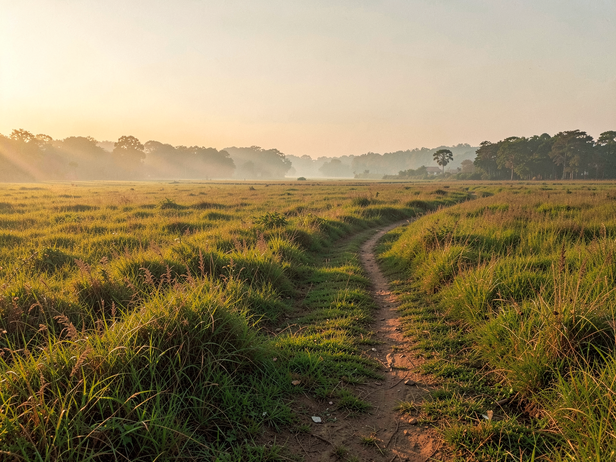
![Indian Floodplain Dawn]()
Indian Floodplain Dawn
Image credit : AI
Early morning light paints the Indian floodplain. A quiet dawn before the India national park safari season begins.
Practical Realities of Booking the Early Season
Safari permits at Kanha, Bandhavgarh, and Ranthambore are booked through the forest department's online portal, and October dates, especially the first two weekends, sell out within hours of becoming available, typically six months in advance. Tadoba's buffer zones are easier to book and offer a genuine alternative to the core zone in the early weeks. Accommodation inside and around the parks ranges from forest department rest houses, where a room can cost between ₹1,500 and ₹4,000 a night, to private lodges that start around ₹8,000 per person per night and reach considerably higher at the better-known properties near Bandhavgarh and Kanha. The early season is not the budget season: demand is high and operators know it. Fly into Jabalpur for Kanha and Bandhavgarh, Nagpur for Tadoba and Pench, Ramnagar for Corbett, and Jaipur or Sawai Madhopur for Ranthambore. Road conditions on the last stretch to most parks improve quickly once the rains stop, but confirm with your lodge before driving in the first week of October.
What Makes the Early Season Worth the Uncertainty
The birding in October and November is exceptional in ways that even dedicated wildlife visitors underestimate. Migratory species begin arriving from Central Asia and the Himalayas in October, bar-headed geese over Kaziranga, various waders at Ranthambore's lakes, raptors moving through the central Indian highlands. The light in October is different from the harsh white of March and April: it is golden in the mornings and holds longer into the evening, which matters enormously for photography. The parks are quieter than they will be in December and January, when school holidays and the peak tourism season fill every zone. A jeep that stops at a sighting in October is often the only jeep there. That is not a small thing.