The train from Kraków to Prague takes roughly seven hours with one change at Wrocław, and that change is not a nuisance, it is the whole point. Three cities, two countries, one corridor of Central Europe that most itineraries split into separate trips. Done together, they form a single argument: that the most interesting part of a European journey is often what connects the famous stops, not the stops themselves.
Kraków: Start Where Poland Is Still Legible
Kraków was not bombed flat in the Second World War, which makes it almost singular in this part of Europe. The Rynek Główny, the main market square, is the largest medieval square on the continent, and it functions as a genuine public space rather than a museum exhibit. Cloth Hall runs down its centre. The Mariacki Basilica anchors one corner, its two unequal towers the result of a construction dispute that was never resolved. The trumpet call from the taller tower plays every hour, stops mid-phrase, and has done so since the thirteenth century.
Kazimierz, the old Jewish quarter to the south, is where Kraków earns its second day. The neighbourhood was largely destroyed and its community murdered during the war; what remains is a place that holds that history without being consumed by it. Synagogues, bookshops, and restaurants share the same narrow streets. The Galicia Jewish Museum on Dajwór Street is the most honest account of what happened here that you will find in a building. Allow two nights in Kraków minimum. The Wawel Castle and its dragon legend will take a morning. The salt mines at Wieliczka, thirty minutes by commuter train, will take another.
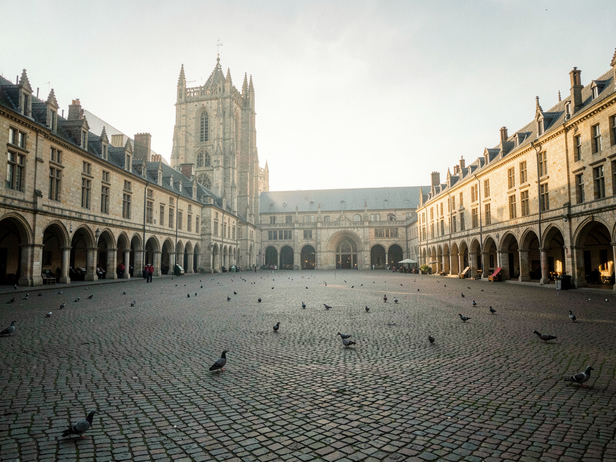
![Medieval Market Square Dawn]()
Medieval Market Square Dawn
Image credit : AI
I witness the pale golden dawn light raking across the stone facades of a medieval European market square, a scene reminiscent of the Kraków to Prague train route.
The Train to Wrocław and Why You Should Not Skip It
The PKP Intercity train from Kraków Główny to Wrocław Główny runs several times daily and takes roughly three and a half hours. Book through the PKP Intercity website; prices are low by Western European standards, and the Pendolino-class trains on this corridor are fast and comfortable. The journey crosses the Silesian plain, flat and agricultural, which gives you time to read or watch the light change over the fields.
Wrocław is the city that rewards the traveller who has done no research. It was German until 1945, then called Breslau, ethnically cleansed, bombed, and handed to Poland as part of the postwar border realignment that shifted the entire country westward. The population that arrived to rebuild it came largely from Lwów, now Lviv in Ukraine, itself expelled from a city that had been theirs for centuries. Wrocław carries this layered displacement quietly. The rebuilt Old Town is meticulous enough that you would not know it was largely reconstructed, and the Market Square here rivals Kraków's in scale and outlasts it in personality. The city sits on the Oder River across twelve islands connected by over a hundred bridges. Walking between them without a map is the correct approach. Allow at least one full day, ideally two. The gnomes, small bronze figures scattered across the city, each with a different occupation, are a tourist gimmick that somehow works.
Wrocław to Prague: The Czech Border and What Changes
The train from Wrocław to Prague takes roughly four hours on the direct service, passing through Pardubice and into Bohemia. The border crossing is invisible, you will not notice it except that the station signs change language and the coffee gets slightly better. Praha Hlavní Nádraží, Prague's main station, is itself worth arriving into: an Art Nouveau building from 1909 with a restored upper hall that most passengers walk straight past on their way to the metro.
Prague needs no introduction and resists the one you arrive with. The crowds on Charles Bridge at midday are real, and so is the disappointment. Go at six in the morning, before the tour groups, and the bridge is empty stone over grey water and you understand immediately why people have been writing about it for seven hundred years. The castle district, Hradčany, sits above the city on the left bank and takes a half-day to move through properly. Josefov, the old Jewish quarter, is smaller than Kazimierz but the Old Jewish Cemetery, where graves were stacked in layers because the community was not permitted to expand the burial ground, is one of the more sobering places in Europe. The astronomical clock on Old Town Square performs every hour and is less interesting than the square itself at any other moment.
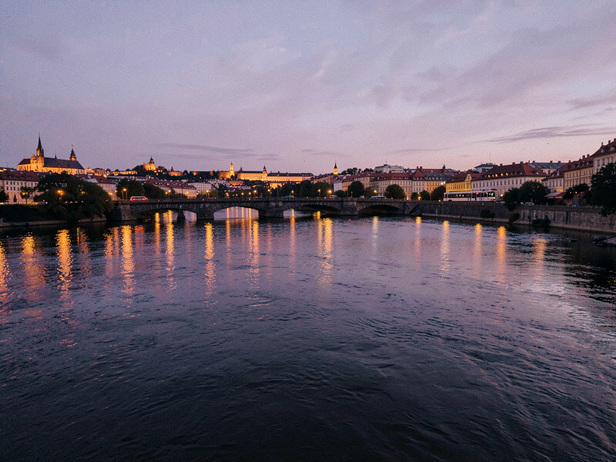
![River City Dusk Panorama]()
River City Dusk Panorama
Image credit : AI
I photograph a Central European river city at dusk, a beautiful scene for a Kraków to Prague by train journey.
Practical Notes for the Corridor
The full route, Kraków to Wrocław to Prague, works in either direction, but westward feels more natural because Prague is the city most travellers have already imagined and Kraków is the one that surprises them. Flying into Kraków John Paul II Airport and out of Prague Václav Havel Airport keeps the journey linear and eliminates backtracking.
October is a strong month for this corridor. Crowds thin after the summer peak, the light is low and golden in the afternoons, and neither city has yet shifted into Christmas market mode. Accommodation in Kraków and Wrocław is significantly cheaper than Prague; budget accordingly. The Polish złoty and the Czech koruna are both separate from the euro, so carry local currency for smaller purchases. Rail passes covering both Poland and Czechia exist but rarely save money on this specific corridor, point-to-point tickets booked in advance are usually cheaper.
The total rail distance from Kraków to Prague is roughly 650 kilometres. By air with transfers it takes the same time and costs more. By train you arrive in the centre of each city, see the country between them, and do not spend an hour on a bus from a peripheral airport. The journey is the itinerary, not the interruption to it.