Ruskin Bond has lived in the same house on Landour hill since 1963, and the Mussoorie he writes about is not a reconstructed past, it is the town as it still partly exists, if you know which lane to turn down. The circuit below takes two full days at a comfortable pace, starts in Mussoorie's Mall Road and climbs to Landour Bazaar, then loops back through the quieter deodar forest paths that appear again and again in his short stories. Bring a light jacket even in October; the temperature drops sharply after four in the afternoon.
Mall Road to Landour Bazaar: the climb that earns the view
Start at Kulri end of Mall Road, where the tourist density thins and the shops begin to look like they have been there longer than the tourists. Walk east past the Picture Palace, Bond has written about watching films here as a boy, and begin the climb toward Landour. The road narrows and steepens past the Char Dukan crossroads, a cluster of four old shops where residents have taken tea for generations and where Bond himself still appears on weekend mornings. The chai here costs around thirty rupees and the view across the Doon Valley is unobstructed. Do not rush this stop. The light on the valley below is the light Bond describes in The Room on the Roof, and it is easier to understand the book once you have sat here and watched it change.
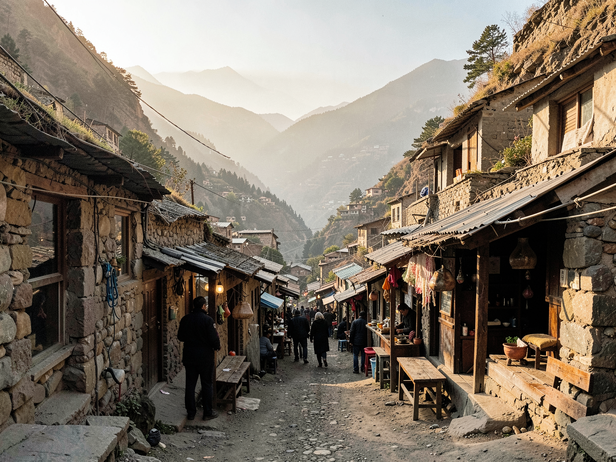
From Char Dukan, the lane continues up to Landour Bazaar proper, a single steep street of small provision shops, a cobbler, a couple of bakeries, and a pharmacy that has been in the same family for decades. The bazaar serves the local Landour community more than it serves visitors, and that is exactly what makes it worth the climb. The Landour Community Hospital sits just above, built by American missionaries in the nineteenth century and still operating. Bond has written about it in his memoir, and the building itself, stone and quiet, looks exactly as old as it is.
![Himalayan Hill Bazaar Lane]()
Himalayan Hill Bazaar Lane
Image credit : AI
I explore a charming Mussoorie Landour Char Dukan walk, soaking in the golden afternoon light and Himalayan charm.
Ivy Cottage and the lanes above it
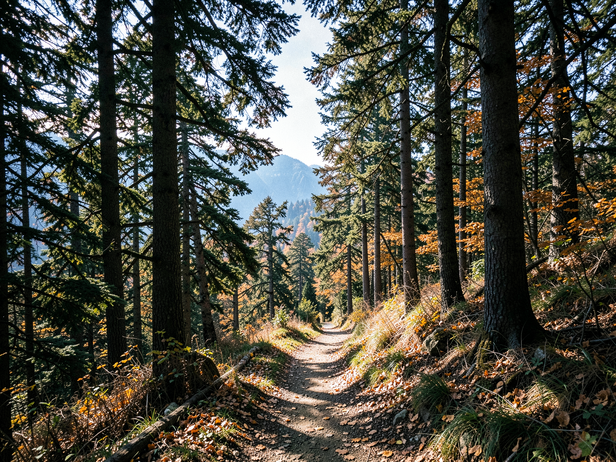
Bond's home, Ivy Cottage, sits above the bazaar on a lane called Mullingar Hill. It is a private residence and visitors do not knock, this is not a museum and he is not a monument. But the lane itself is public and the walk up through the deodar and oak forest is the walk he has described in dozens of pieces: the sound of the wind in the deodars, the leopard that occasionally crosses the path at dusk, the way the mist comes in from the west and makes the ridge disappear. October is a good month because the post-monsoon clarity holds, the rhododendrons are not yet in bloom to distract everything, and the forest floor is damp enough to smell of leaf and bark. Walk slowly. The lane is narrow and the drop on one side is real.
Cambridge Book Depot on Mall Road stocks Bond's work and is the only place in Mussoorie where you are likely to find his out-of-print collections alongside the current paperbacks. The owner knows the stock. If you want to read something on the hill itself, pick up a copy of Our Trees Still Grow in Dehra or the collected Ruskin Bond omnibus before you start the Landour climb, and read a story in the evening at Char Dukan with the valley going dark below you.
The Camel's Back Road and the forest loop
The Camel's Back Road is a three-kilometre loop that runs along the ridge west of Mall Road, named for a rock formation that does, from one angle, resemble a camel lying down. Bond has used it as a setting for evening walks in several stories, and it earns its place in the circuit because it is the quietest stretch of road in Mussoorie, no cars after a certain point, occasional horses, and a view north toward the snow line that appears and disappears with cloud cover. Walk it in the late afternoon when the light is horizontal and the shadows of the deodars stretch across the road. The return leg brings you back to Mall Road near the Library end, which is the older, quieter part of town.
From Library Bazaar, the forest path toward Benog Wildlife Sanctuary begins, a longer option for those with a third day. Bond has written about Benog's bird life with the specificity of someone who has walked it often: the Himalayan barbet, the kalij pheasant, the lammergeier riding thermals above the ridge. The sanctuary itself requires a small entry fee and is managed by the Uttarakhand forest department. The trail is well-marked for the first two kilometres and then requires a local guide. Hire one from Landour Bazaar the evening before; the going rate is around five hundred rupees for a half-day walk.
![Himalayan Forest Path]()
Himalayan Forest Path
Image credit : AI
Exploring the literary walks Mussoorie hills, this path feels like stepping into a Ruskin Bond story.
Getting there, staying, and the October window
Mussoorie is 290 kilometres from Delhi. The fastest route is to take a train to Dehradun, the Shatabdi from New Delhi station covers it in about five hours, and then a shared taxi or cab from Dehradun's railway station to Mussoorie, which takes another hour and costs between three hundred and five hundred rupees depending on whether you share. Buses run from Dehradun's ISBT and are cheaper but slower on the switchbacks.
Stay in Landour rather than on Mall Road if the circuit is the point. There are a handful of small guesthouses in and around Landour Bazaar, Rokeby Manor is the most established, with rooms starting around four thousand rupees a night in October. The smaller guesthouses near Char Dukan run cheaper and put you closer to the forest sounds at night. Book ahead; October is peak season and Landour has limited beds.
The October window specifically matters because the monsoon has cleared, the roads are dry, the valley is visible rather than cloud-buried, and the deodar forest has that particular damp-and-clear quality that Bond's October writing keeps returning to. November works almost as well. December brings cold that requires a different kind of packing and closes some of the smaller guesthouses.
What the walk actually gives you
Bond's Mussoorie is not a lost world. The town has changed, the Mall Road is louder than it was, the cable car brings more visitors to the Gun Hill viewpoint than the hill can comfortably hold on a weekend, and the forest above Landour is under the same pressure every Himalayan forest is under. But the specific geography that makes his fiction feel grounded, the ridge, the bazaar, the deodar slope, the view of the valley, is still exactly where he put it. The walk does not unlock the stories. It shows you that he was not romanticising a place he invented. He was describing one that exists, and that is a different kind of thing to understand about a writer.