India retired steam from mainline service in 1995, but retirement here was never quite final. Across four cities and one set of mountain gradients, locomotives that should be museum pieces are oiled, fired, and sent out on schedule. The traveller who knows where to look finds not a nostalgia exhibit but a working inheritance, iron and steam doing the job they were built to do.
National Rail Museum, Delhi: The Archive That Breathes
The National Rail Museum in Chanakyapuri holds the largest collection of historic rolling stock in Asia, over 100 locomotives and carriages spread across ten acres of outdoor track and three indoor galleries. The numbers are well known. What the brochure undersells is the texture of the place: the smell of old grease on warm metal in the afternoon sun, the way the Fairy Queen sits in its shed looking less like an exhibit and more like something interrupted mid-journey.
The Fairy Queen, built in 1855 by Kitson Thompson and Hewitson in Leeds, holds a Guinness record as the world's oldest working steam locomotive. It runs excursions on a seasonal schedule between Delhi and Alwar, roughly 180 kilometres of Rajasthan scrubland, and a seat on it is not a theme park ride. The engine breathes. It leaks. It makes the sounds of a machine under genuine effort. Book through IRCTC when the season opens, usually October through February, and expect the berths to fill weeks ahead.
The museum's indoor galleries carry the other half of the story: the Viceregal saloon of 1886, the Maharaja of Mysore's private carriage with its silk upholstery intact, the monorail coach from Patiala that looks like a fever dream of the 1907 engineering imagination. The toy train circuit around the grounds runs on diesel and is aimed at children, but the outdoor static collection surrounding it rewards an unhurried hour with no particular destination.
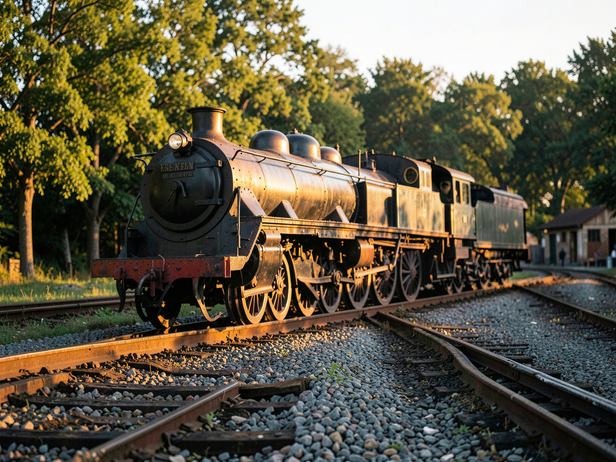
![Golden Light on Steam Engine]()
Golden Light on Steam Engine
Image credit : AI
I photographed a majestic steam locomotive at a railway museum, highlighting its vintage charm in the golden morning light. A must-see for railway museums India.
Mysuru Rail Museum and the Sheds Behind It
The Mysuru Rail Museum sits on a quieter register than Delhi, smaller, less visited, and for that reason easier to spend real time in. The centrepiece is a working turntable, which is rarer than it sounds: most turntables in India were decommissioned when steam ended and the infrastructure around them was repurposed. This one still rotates locomotives for display and, on announced demonstration days, for the pleasure of watching a 100-tonne engine pivot on its axis with surprising grace.
The more interesting visit in Mysuru is the loco shed adjacent to the heritage precinct, where the narrow-gauge engines that once served the Mysore Maharaja's private railway are maintained. Access requires permission from the Divisional Railway Manager's office, which is not difficult to obtain if asked politely and in advance. What you find inside is not a museum but a workshop: the smell of cutting oil, the sound of a hammer on a flange, men in overalls who know the name of every part they are touching. The engines here run the heritage train on the Mysuru-Nanjangud stretch on select weekends; the schedule is posted at the station and on the South Western Railway zone's notice boards rather than on any app.
Mysuru pairs naturally with a day in the city itself. The distance from the museum to the Mysore Palace is under three kilometres. The Devaraja Market, a ten-minute walk from the palace, sells the jasmine garlands and sandalwood soaps that every travel piece mentions, but also dried kokum, Coorg coffee, and the particular kind of hand-pounded spice mix that does not survive the journey home in a suitcase without wrapping in three layers of newspaper first.
Howrah and the Eastern Railways Heritage Fleet
Howrah Junction is the busiest railway station in India by platform count, 23 platforms, a footbridge that at peak hour feels like a river running uphill, and not an obvious place to look for heritage. The heritage is in the shed, not the station. The Howrah loco shed, operated by the Eastern Railway zone, maintains a small fleet of steam locomotives kept in working order for special trains, film shoots, and the occasional charter. The shed is not a tourist facility and does not present itself as one. Entry is by prior arrangement with the Divisional Railway Manager, Howrah Division, and the arrangement is more straightforward than it sounds: a written request, a response within a week or two, and a morning spent watching engineers do work that has not changed in its fundamentals since the 1920s.
The steam fleet here includes WP-class Pacifics, the broad-gauge passenger engine that pulled the Rajdhani and the Frontier Mail before electrification arrived, and the smaller WG freight engines, which were built in such numbers between 1950 and 1970 that parts remain available. The WP class, designed partly at Chittaranjan Locomotive Works in West Bengal, is one of the few steam engine types to have been designed and built substantially on Indian soil. Chittaranjan, about 250 kilometres northwest of Kolkata, built its last steam locomotive in 1972 and switched to electric traction. The locomotives it made are still the ones being maintained in the Howrah shed.
Howrah itself is worth arriving into rather than through. The station's main hall, built in 1905 and expanded in 1906, carries the particular grandeur of colonial infrastructure built to impress: high ceilings, wide arches, the sense that the building was designed for a volume of human movement that has only grown since. Cross the Hooghly on the Howrah Bridge, 705 metres of cantilever steel, no nuts or bolts, only rivets, opened in 1943, and the city opens onto the Strand, the ghats, and the noise of a place that has never decided it is finished becoming itself.
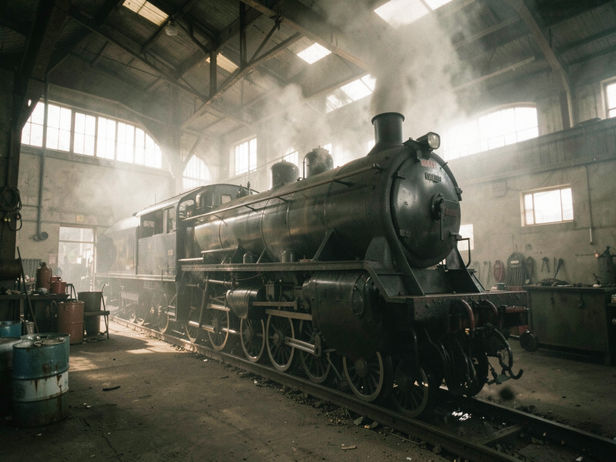
![Morning Light on Steam Engine]()
Morning Light on Steam Engine
Image credit : AI
A broad-gauge steam locomotive bathed in morning light within a working shed. A glimpse into heritage train journey India.
The Hill Railways: Steam at Altitude
Three of India's hill railways carry UNESCO World Heritage status: the Darjeeling Himalayan Railway, the Nilgiri Mountain Railway between Mettupalayam and Ooty, and the Kalka-Shimla Railway. Of the three, two still run steam traction on portions of their route, and the third runs it on heritage specials.
The Darjeeling Himalayan Railway uses B-class steam locomotives, 0-4-0 saddle tanks, built between 1889 and 1925, with a few later additions, on the Darjeeling Joy Ride, a two-hour return trip from Darjeeling station to Ghoom and back. Ghoom, at 2,258 metres, is the highest railway station in India. The engine on this run is not a replica and not a restoration in the sense of a museum piece returned to cosmetic condition: it is a locomotive that has been in continuous service, repaired as needed, and kept running because the railway needs it to run. The coal is real, the smoke is real, and the gradient up to Batasia Loop, where the track loops back on itself to gain height, is steep enough that the engine audibly labours.
The Nilgiri Mountain Railway uses rack-and-pinion technology on the lower section between Mettupalayam and Coonoor, where the gradient reaches 1 in 12.28, among the steepest adhesion-plus-rack gradients in the world. The X-class steam locomotives that work this section were built by the Swiss Locomotive and Machine Works in the 1920s and maintained at the Golden Rock workshop in Tiruchirappalli. They are irreplaceable in a literal sense: no new rack-and-pinion steam locomotive of this type is being manufactured anywhere, and the railway maintains them with a combination of manufactured spares, cannibalised parts from retired engines, and engineering judgment that has accumulated across generations of workshop staff. The train from Mettupalayam departs early morning; the climb through the Nilgiri foothills in the first light, with the valley dropping away below the carriage window, is one of the few travel experiences in India that does not require any embellishment to describe.
The best time to travel any of the hill railways is October through early December, after the monsoon has cleared and before the winter haze settles. Advance booking on the Nilgiri line fills quickly; the Darjeeling Joy Ride can usually be booked a few days ahead at the station itself, though the first morning departure goes fastest.
Steam in India was never a single thing, it was broad gauge and narrow gauge, British-built and Indian-built, mountain rack and plains express. What survives is not a curated sample but whatever the railways found too useful or too expensive to stop. The Fairy Queen runs because someone calculated it was cheaper to maintain than to replace. The Nilgiri X-class runs because no diesel can manage that rack section without a redesign no one has funded. The Howrah WPs are kept because they are still needed for charters and shoots and the occasional special that a diesel cannot replicate in atmosphere. The heritage, in other words, is accidental, which is precisely why it feels real.