Stand at the right bank of the Triveni Sangam in Prayagraj on a January morning and the scene is not what most visitors picture. There is no dramatic rush of colour where rivers crash together. Instead, two enormous bodies of slow-moving water simply stop being separate, a blurred seam, a slight change in surface texture, the Yamuna running marginally darker than the Ganga beside it. The mythology is immense. The landscape is vast and quiet and a little anticlimactic, until you understand that the scale itself is the spectacle.
Prayagraj: The Confluence That Earns Its Reputation Through Sheer Size
The Triveni Sangam, where the Ganga, Yamuna, and the subterranean Saraswati are said to meet, sits at the eastern edge of Prayagraj, accessible by boat from the Sangam Ghat. The Yamuna arrives from the south, visibly narrower and carrying a slightly greener tinge depending on the season. The Ganga runs broader, the colour of milky tea in winter, pale silver in the dry months. The meeting point shifts with the season and the monsoon runoff; boatmen know where it is by reading the water, not by looking at a fixed marker.
The Kumbh Mela, held here every twelve years in its full form and every six in the Ardh Kumbh cycle, draws tens of millions of pilgrims to bathe at the confluence. Outside those windows, the ghats are quiet enough that you can hear the oars. The best visual moment is at dawn, when the mist sits low and the two tones of water are most distinct. Come in October or November, after the monsoon has cleared but before the cold haze thickens, for the clearest view of where one river ends and the other begins.
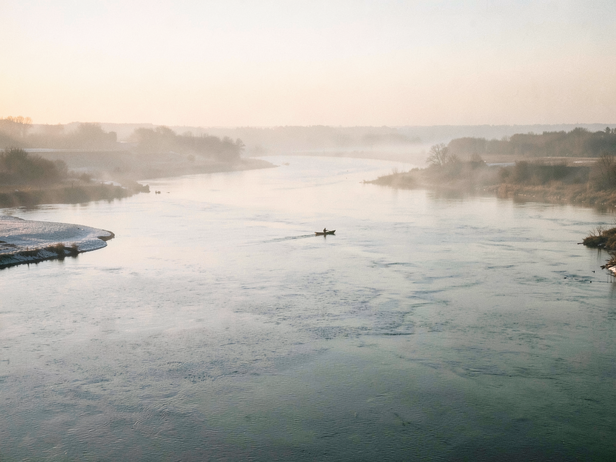
![Dawn River Confluence]()
Dawn River Confluence
Image credit : AI
I observe the serene confluence of two mighty rivers at dawn, a scene of profound stillness. This is a view of the Triveni Sangam.
Devprayag: Where the Alaknanda and Bhagirathi Become the Ganga
Of all the Panch Prayag, the five sacred confluences along the Alaknanda in Uttarakhand, Devprayag is the one that looks exactly as dramatic as it sounds. The town clings to a steep hillside above a narrow gorge. Below, the Bhagirathi runs cold and blue-grey from the Gangotri glacier. The Alaknanda comes in green, carrying the warmth of a longer, lower journey through the hills. They meet at a sharp angle, and for fifty metres or more downstream, the two colours run in parallel before blending. This is the point where the river officially becomes the Ganga.
The viewing spot is a small platform at the tip of the rocky promontory between the two rivers. You stand perhaps four metres above the water. The sound is constant, both rivers are fast here, churning white at the edges, and the contrast in colour is visible to the naked eye without any particular light or time of day. Devprayag sits on the Rishikesh-Badrinath highway, roughly 70 kilometres from Rishikesh. The town itself is small, with a handful of guesthouses and the ancient Raghunath temple at the confluence point. Most people stop for two hours. It is worth a night.
Rudraprayag and Karnaprayag: The Less-Visited Middle Confluences
Rudraprayag, where the Mandakini meets the Alaknanda, is a transit town for pilgrims heading to Kedarnath. The confluence is visible from the main road bridge, which means most people see it through a bus window. Those who stop find a narrower, more intimate meeting than Devprayag, the Mandakini comes down from a tighter valley and hits the Alaknanda at a gentler angle. The colour contrast is less pronounced, but the surrounding hills are closer and the scale is more human.
Karnaprayag, where the Pindar joins the Alaknanda, is the quietest of the five. The town has almost no tourist infrastructure beyond the confluence itself. The Pindar drains the Pindari glacier and runs cold and clear; in October, after the monsoon sediment has settled, it carries a faint turquoise that reads as genuinely surprising against the Alaknanda's green. The Uma Devi temple sits directly above the meeting point. There is no crowd, no boat, no ceremony on an ordinary day, just the rivers and a few locals who have stopped noticing.
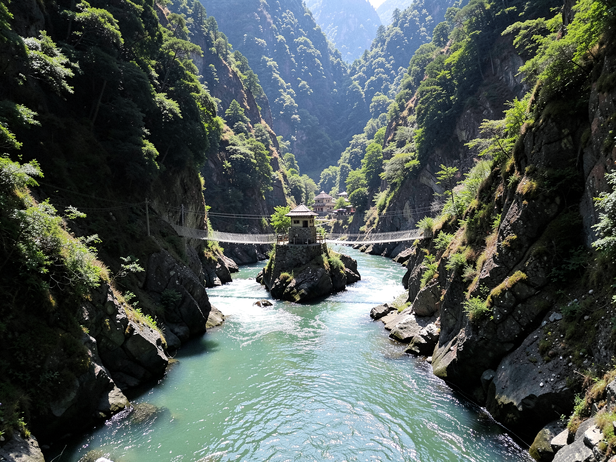
![Himalayan River Confluence]()
Himalayan River Confluence
Image credit : AI
I witness the sacred sangam towns of India, where two rivers meet amidst steep, forested slopes and a historic stone temple.
Sangam at Srinagar Garhwal and the Nandprayag Detour
Nandprayag, where the Nandakini meets the Alaknanda, sits between Karnaprayag and Chamoli and is the easiest of the Panch Prayag to miss. The confluence is below the road level, reached by a short stone staircase. The Nandakini is the smallest of the tributaries in the series, and the meeting is subtle, less a visual drama than a moment of attention. A small Gopalji temple marks the spot. The town has one tea stall that reliably has gas.
Vishnuprayag, the fifth and highest of the Panch Prayag, is where the Dhauliganga meets the Alaknanda near Joshimath. The confluence is inside a narrow canyon; the road runs above it and the view down is vertiginous. A hanging bridge crosses the gorge close to the meeting point. Both rivers are fast and loud here, and the canyon walls are close enough that the light only reaches the water directly for a few hours around midday. It is the most physically dramatic of the five and the least visited for its own sake, since most travellers are in transit to Badrinath.
Triveni Sangam at Nasik and the Southern Confluences
Not every sangam sits in the mountains. The Triveni Sangam at Nashik, where the Godavari, Vaitarna, and Kapila are said to meet near Ramkund, is a ghat experience rather than a landscape one. The rivers here are modest in size; what you see is a busy bathing ghat in a dense urban neighbourhood, with the confluence marked by a stone platform rather than visible by the water's colour. The Kumbh Mela rotates to Nashik every twelve years, and the Godavari's banks fill with pilgrims in a way that temporarily transforms the scale of the place.
The Sangam at Srirangapatna in Karnataka, where the Kaveri splits and rejoins around the island, is a different kind of confluence, a river wrapping itself around a piece of land rather than two rivers meeting. The island town holds Tipu Sultan's fort, the Ranganathaswamy temple, and a landscape that is flat, green, and distinctly Deccan. The water here is warm and slow, the light in October and November golden and horizontal in the late afternoon. It reads as a river delta in miniature, and the visual logic is entirely unlike the mountain sangams of the north.
Each confluence rewards the traveller who arrives without a fixed picture of what a sacred river meeting must look like. The Ganga at Devprayag is loud and two-toned and unmistakable. The Godavari at Nashik is a ghat, a city, a crowd. The Kaveri at Srirangapatna is an island. What they share is not an image but a fact of geography, water finding water, and the long human habit of standing at that point and deciding it means something.