The ticket costs less than a meal in either town. The train moves slower than a determined cyclist. And yet both the Matheran Light Railway and the Kalka-Shimla Railway have outlasted the empires that built them, survived proposals to shut them down, and accumulated a waiting list of people who have never been on a train quite like either one. The comparison is worth making honestly, because they are not interchangeable experiences dressed in the same heritage branding.
The Track Itself: What Narrow Gauge Actually Means Here
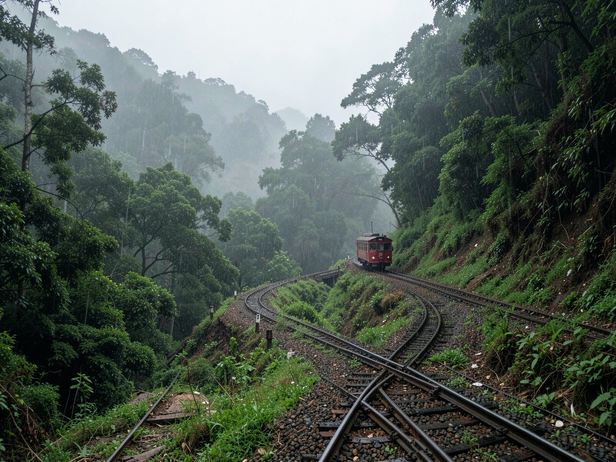
Matheran runs on 2-foot gauge, which is among the narrowest in regular passenger service anywhere in the world. The coaches are roughly the width of a large sofa. Sitting by the window, your elbow clears the outer wall by centimetres. The line runs 21 kilometres from Neral Junction up to Matheran at roughly 800 metres, gaining close to 600 metres in elevation along the way. There are 281 curves on that climb. The train does not power through them; it eases around each one at a pace that lets you watch the curve arrive and resolve.
Kalka-Shimla runs on 2-foot 6-inch gauge, slightly wider, and covers 96 kilometres from Kalka at the foothills to Shimla at just over 2,000 metres. The elevation gain is nearly 1,500 metres. The line passes through 102 tunnels, crosses 864 bridges, and completes 919 curves. These are not decorative statistics. The tunnels are short and frequent enough that the light inside the carriage shifts every few minutes. The longest tunnel, the Barog Tunnel at just over a kilometre, has its own story: the engineer who miscalculated its bore from both ends, was fined one rupee by the colonial administration, and is said to have taken his own life before the corrected tunnel was completed. The replacement engineer, H.S. Harrington, finished it in 1903.
![Sahyadri Hillside Miniature Railway]()
Sahyadri Hillside Miniature Railway
Image credit : AI
I ride the Matheran Light Railway, a heritage narrow gauge hill train winding through the misty Sahyadri mountains.
Getting There and What It Costs to Ride
Neral is about 60 kilometres from Mumbai by road or rail. The Heritage Special on the Matheran Light Railway runs a handful of times daily; a first-class ticket on the toy train costs a few hundred rupees, and the journey takes roughly an hour and a half. Matheran itself bans motor vehicles, so the train is not a scenic detour from the main route, it is the only route if you do not want to walk or take a horse from the base.
Kalka is connected to Delhi by the Shatabdi Express, a four-hour journey. From Kalka, the Shivalik Deluxe Express and the Himalayan Queen are the trains worth taking; the Kalka-Shimla Rail Motor is faster but narrower in experience. Journey time runs between five and six hours depending on the service. A first-class window seat on the Shivalik Deluxe costs under a thousand rupees. Book well ahead between April and June and again in October, when the route is at capacity.
What the Ride Is Actually Like
Matheran in the monsoon is a different journey from Matheran in November. Between June and October, the forest closes in tight on both sides, waterfalls appear at the edge of the track, and visibility drops to the nearest bend. The mist is not atmospheric decoration; it is thick enough to feel on your face through the open window. In the dry months, the Sahyadri ridgeline opens up and the views stretch west toward the coast. The train stops at Waterfall Point during the monsoon, which is less a station than a place where the driver slows so passengers can lean out.
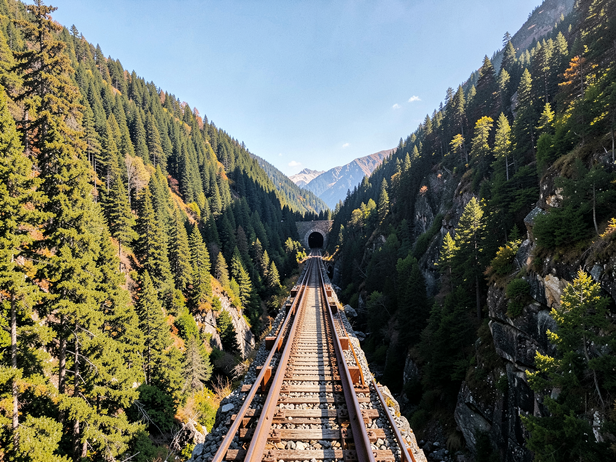
Kalka-Shimla is at its most legible in October, after the monsoon has cleared and before the high-altitude cold sets in. The pine forests are dry-green and still. The valleys drop sharply on one side of the track for long stretches, and the bridges over them are narrow enough that looking down is a genuine decision. In winter, snow on the upper section slows the train further and occasionally stops it. The line was built for the British administration's summer capital and it still carries the faint administrative logic of that purpose: Shimla at the top, everything below it subordinate.
![Himalayan Valley Railway Bridge]()
Himalayan Valley Railway Bridge
Image credit : AI
I capture this view of a narrow-gauge railway bridge, a testament to heritage mountain railways India travel, spanning a vast Himalayan valley.
UNESCO Status and What It Protects
Both lines are part of the Mountain Railways of India inscription, which the UNESCO World Heritage Committee granted in phases, Darjeeling first in 1999, Nilgiri added in 2005, and Kalka-Shimla in 2008. Matheran is not part of the inscription. This distinction matters less to the experience than the listing's bureaucratic implication: the Kalka-Shimla route has a degree of protection from route modification that Matheran, which has faced closure proposals and track damage from landslides, does not enjoy in the same formal way.
The Matheran line was built by Abdul Hussein Adamjee Peerbhoy and opened in 1907. The Kalka-Shimla line was built by the Delhi-Ambala-Kalka Railway and completed in 1903. Both were built to carry people uphill to places the plains heat made unbearable. The technology is essentially the same, rack-and-pinion was considered and rejected on both routes in favour of adhesion-only traction on steep gradients, which is part of why the curves are so numerous and so tight.
Which One to Choose
The distance from Mumbai makes Matheran the easier day-trip or weekend decision for anyone based in Maharashtra. The journey up is the destination as much as the hill station itself, and the vehicle ban at the top means the train's logic extends beyond the ride. For anyone travelling to Himachal Pradesh or passing through Delhi, Kalka-Shimla offers a longer, more varied, and historically denser experience, the tunnels alone change the quality of the journey in a way that Matheran, which runs mostly in open air, does not replicate.
If the question is which ride is more dramatic, Kalka-Shimla wins on scale. If the question is which ride is more intimate, Matheran wins on proximity, to the forest, to the track, to the other passengers sharing a carriage the width of a corridor. They are not competing for the same thing. The gauge is different, the mountain range is different, and the feeling at the top is different. What they share is the particular patience a slow train requires, and the particular attention it rewards.