Most people who land in Thailand are pointed south within forty-eight hours. The northern loop asks you to resist that pull entirely, and what you find when you do is a country that has almost nothing to do with the one on the postcards.
Chiang Mai: The Walled City as a Base, Not a Destination
Chiang Mai's old city is a square moat with a temple inside every few hundred metres, and the instinct is to tick them off. Resist it. Wat Chedi Luang is worth a full hour at dusk when the monks walk the perimeter in single file and the chedi catches the last light. Wat Suan Dok on a Monday evening runs a monk-chat session where the conversation is genuinely unrehearsed. The rest of the temples blur into each other after the third day, and that is fine, the city is better used as a place to eat, to sleep well, and to understand the north's relationship with Myanmar and Yunnan before you move deeper into it.
The Nimman neighbourhood northwest of the moat is where the coffee is serious and the Saturday Walking Street on Wualai Road is where the silver-work is. Northern Thai food is a distinct cuisine: khao soi, the coconut-curry noodle soup with crispy noodles on top, is the dish to order at Khao Soi Khun Yai or Khao Soi Mae Sai rather than any restaurant that lists it in English first. Sai oua, the herbed pork sausage, and nam prik noom, the roasted green-chilli dip, are the things to eat at the Warorot market before it gets hot.
Budget roughly 800 to 1,200 baht a night for a clean guesthouse inside the moat. Three nights is the minimum to feel unhurried. Four is better.
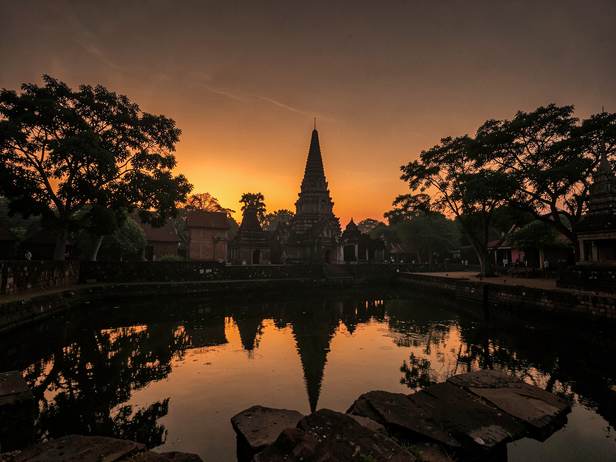
![Ancient Thai City at Dusk]()
Ancient Thai City at Dusk
Image credit : AI
I explore a serene ancient walled city in northern Thailand, a perfect destination for slow travel northern Thailand.
The Road to Pai: 762 Curves and What Waits on the Other Side
The minivan from Chiang Mai to Pai takes three hours across a mountain road the Tourism Authority of Thailand has counted at 762 curves. The number is accurate enough to be useful: if you are prone to motion sickness, take the bus in the morning when the road is cooler and your stomach is empty, and sit at the front. The road climbs through pine forest that looks nothing like tropical Thailand, which is the first sign that the north operates by different rules.
Pai is a small town that was discovered by backpackers in the 1990s and has been in a slow argument with itself about that ever since. The main street is now full of crêpe stands and reggae bars, which is easy to walk past. What is harder to reach but worth the effort: the Pai Canyon at sunset, a ridge of eroded sandstone that turns amber and then red while the valley below goes dark; the World War II Memorial Bridge, a Japanese-built bamboo and teak structure over the Pai River that floods every rainy season and gets rebuilt; and the hot springs at Tha Pai, which are a genuine geothermal spring and not a hotel pool with the temperature turned up.
Pai is best in the cool season, November through February, when the mornings are cold enough for a jacket and the rice fields in the valley have just been harvested. In October, when this route runs, the hills are green and the waterfalls are full, but the roads to some viewpoints will be muddy. A rented scooter for 150 to 200 baht a day handles most of what you need to see. Two nights in Pai is enough; three if you find a guesthouse on the river and decide the hammock is more important than the itinerary.
Nan: The Province That Kept Itself
Nan is the reason to do this loop rather than turn back. It sits in a narrow valley near the Laos border, accessible by bus from Pai via Chiang Mai or directly by a longer mountain road, and it has managed to remain genuinely unvisited in a way that has become rare in northern Thailand. The province was semi-autonomous until 1931, and that separateness is still legible in the architecture, the dialect, and the temples.
Wat Phumin in Nan town is the one temple in the north that stops you. Built in 1596 and restored in the late nineteenth century, it holds a set of murals painted by a Tai Lue artist known as Thit Buaphan that document everyday life in the Nan valley, traders, lovers, foreign soldiers, women at the river, with an intimacy that religious painting rarely allows. The murals cover every wall. The famous detail is a man whispering into a woman's ear in the lower-left corner, a gesture so specific and so human that it has become the image most associated with Nan. The National Museum next door, housed in a former palace, holds a black elephant tusk that was tribute paid to Bangkok and is worth the fifty-baht entry.
Outside the town, the Doi Phu Kha National Park covers the eastern hills and contains Chomphu Phu Kha, a cherry-blossom tree endemic to Nan that flowers in January and February on the high ridges. In October the park is deep green and the waterfalls at Nam Tok Sakoen are running hard. The road through the park to the Mien and Hmong villages requires a guide or a confident driver; the reward is a landscape that looks more like Yunnan than Thailand.
Accommodation in Nan runs from 400 to 900 baht a night at clean guesthouses near the museum. The town has one good night market, a riverside walking street on weekends, and almost no other tourists. That last fact is the main reason to come.
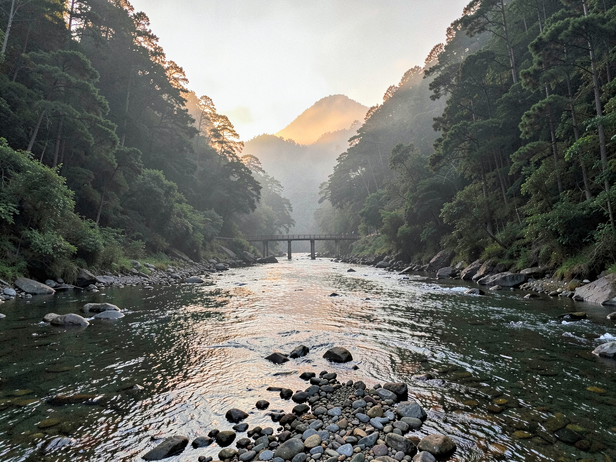
![Misty River Valley Thailand]()
Misty River Valley Thailand
Image credit : AI
I capture the tranquil beauty of a misty river valley in northern Thailand, a perfect scene for slow travel.
Getting Between the Three Without Flying
The loop works best moving west to east: Chiang Mai to Pai by minivan, Pai back to Chiang Mai by minivan, then Chiang Mai to Nan by bus. The Chiang Mai to Nan bus from Arcade Bus Terminal takes around six hours and costs roughly 200 to 250 baht. There is no direct Pai-to-Nan connection that saves time over going back through Chiang Mai, and the road that exists on some maps is not reliably passable in wet season.
The return from Nan to Chiang Mai or to Bangkok can be done by bus or by the daily flight on Nok Air, which takes fifty minutes and costs between 800 and 2,500 baht depending on how far ahead you book. If the budget allows, the flight is worth it: the descent into Nan's valley, with the hills on all sides and the town visible as a small grid below, is the kind of arrival that makes a place feel found rather than arrived at.