The Tamil word for a place you belong to without being born there is sometimes just the name of the street. In Penang's George Town and in Ipoh's Old Town, that belonging is written into the plaster of shophouse walls, into the smoke rising from temple gopurams, and into the particular way a pulled tea lands on a zinc counter at six in the morning. Malaysia's Indian history did not begin in Kuala Lumpur. It began here, in these two towns, carried by people who came to build railways and run money and press oil from coconuts, and who stayed long enough to reshape the architecture of daily life.
George Town: The Chettiar Quarter and Little India's Layered Streets
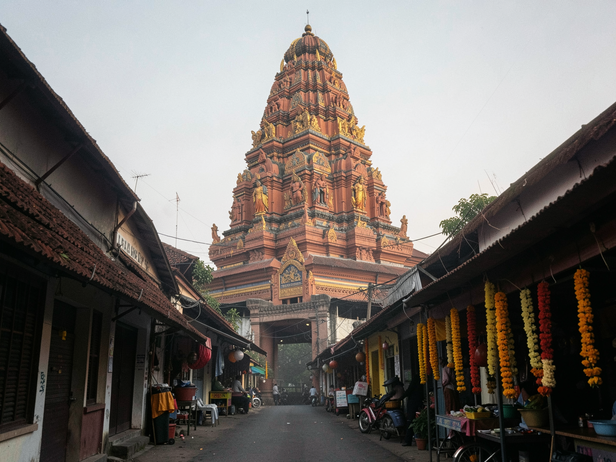
George Town was declared a UNESCO World Heritage Site in 2008, but the designation was for the whole layered city, not just the colonial buildings. The Nattukotai Chettiars, Tamil merchants from the Chettinad region of Tamil Nadu, arrived in Penang in the 18th century as moneylenders and financiers. They built Sri Mahamariamman Temple on Queen Street, one of the oldest Hindu temples in Malaysia, its gopuram stacked with painted figures that face a street that also carries a Chinese clan house and a mosque within a short walk. This is not a curated multicultural display. It is simply how the street was built.
Little India in George Town runs along Lebuh Pasar and Lebuh Chulia and the lanes between them. The garland sellers work from before dawn. The sari shops open early and stay open late. Banana leaf rice is served on actual banana leaf, with the fish curry ladled from a pot that has been on since morning. The neighbourhood is dense and functional and not particularly interested in being photographed, which is part of what makes it worth walking slowly through. The Sri Mahamariamman Temple holds its annual Thaipusam procession along a route that has not changed in over a century, drawing hundreds of thousands. The kavadis are carried on a body that has fasted and prepared. The crowd is not a tourist crowd.
The Penang Peranakan Mansion on Church Street is worth a half-day for anyone interested in how Indian, Chinese and Malay material culture folded into each other over two centuries. The Baba-Nyonya community, descended from early Chinese settlers who intermarried with local Malay and Tamil communities, produced a domestic aesthetic that has no equivalent anywhere else, lacquered furniture, Straits Chinese porcelain, and recipes that use tamarind and coconut milk in combinations that feel simultaneously Tamil and entirely their own.
![South Indian Gopuram's Morning Glow]()
South Indian Gopuram's Morning Glow
Image credit : AI
I capture the serene beauty of a South Indian temple gopuram in Malaysia, a testament to Penang Indian heritage.
The Tamil Estates and the Road to Ipoh
The train from Penang's Butterworth station to Ipoh takes roughly two and a half hours on the KTM intercity line and costs under RM 20, roughly ₹350, in economy class. The journey itself carries history. The railway line through the Kinta Valley was built almost entirely by Tamil indentured labourers brought from South India by the British colonial administration in the late 19th and early 20th centuries. They came to work the rubber estates and the tin mines. Many never returned. The estate communities they formed, with their Tamil schools, their small temples, their specific dialect of Malaysian Tamil, are still present in the landscape between the two towns, though the rubber trees have thinned and the younger generation has largely moved to the cities.
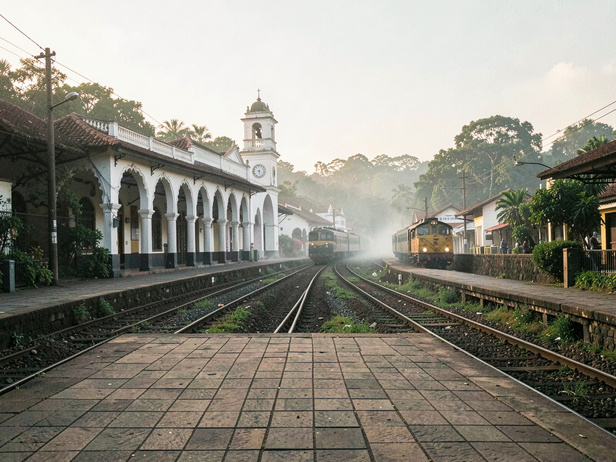
Ipoh grew wealthy on tin. The Kinta Valley held some of the richest tin deposits in the world, and the labour that extracted it was overwhelmingly Tamil. The money that managed it was partly Chettiar. The architecture that resulted, the grand railway station built in 1935, the colonial civic buildings, the shophouse rows of the Old Town, was built on that foundation. Ipoh's Indian community today is concentrated in the streets around the Maha Mariamman Temple on Jalan Bijeh Timah, a temple that has stood since 1898 and whose annual festival closes the surrounding roads for three days.
Ipoh's Old Town: Coffee, Kongsi, and the Tamil Presence
Ipoh's Old Town sits on the western bank of the Kinta River. The white coffee that Ipoh is famous for, pulled strong, sweetened with condensed milk, lighter in roast than Penang's, was developed in the kopitiam culture of the early 20th century, a culture shaped by the intersection of Hainanese coffee-shop operators, Tamil toddy-shop traditions, and the particular working hours of a mining town. The kopitiam at Sin Yoon Loong on Jalan Bandar Timah has been open since 1932. The crowd at seven in the morning is not tourists.
The Tamil presence in Ipoh's Old Town is quieter than in Penang but no less rooted. The Sri Maha Mariamman Temple is the anchor, but the Indian history is also in the names of the streets, some of which carry Tamil transliterations that the colonial surveyors rendered imperfectly, and in the provision shops that still stock curry leaves and dried tamarind and varieties of rice flour that serve a Tamil kitchen specifically. The Ipoh Heritage Trail, a self-guided walk mapped by the Perak State Museum, marks several sites connected to the Indian community, including the old Chettiar banking houses on Jalan Dato Maharajalela, some of which still carry the original carved facades.
![Moorish Station at Dawn]()
Moorish Station at Dawn
Image credit : AI
I'm exploring the heritage of Penang Ipoh travel beyond Kuala Lumpur at this stunning colonial station.
What to Eat, Where to Stay, and When to Go
The practical details matter here because both towns reward slow travel and punish rushing. In Penang, the area around Lebuh Armenia and Lebuh Chulia in George Town has a range of heritage guesthouses in restored shophouses, with prices starting around RM 150 per night (roughly ₹2,600). In Ipoh, the boutique hotels in the Old Town, M Boutique Hotel and the French Hotel are the most cited, run from RM 180 to RM 350 per night. Both towns are hot and humid year-round. The driest months in Penang are between December and February; in Ipoh, the Kinta Valley is relatively sheltered and rain can come at any time, but the mornings are almost always clear.
For food, the specific things worth finding: nasi kandar at Line Clear on Penang's Jalan Penang, which has been operating since 1959 and serves the dish, rice with a selection of curries ladled over, in the original standing-at-the-counter format. In Ipoh, the banana leaf rice at Restoran Yaar on Jalan Sultan Iskandar is a lunch institution. The roti canai at the mamak stalls that open before dawn in both towns is made to a South Indian Muslim tradition that arrived with the Mamak community, Tamil Muslims who came from Tamil Nadu and Kerala and who run the late-night and early-morning food economy of both cities to this day.
The best time to visit for anyone specifically interested in the Indian heritage is around Thaipusam, which falls in January or February depending on the Tamil calendar. The Penang procession is one of the largest outside India. Deepavali in both towns is celebrated with a particular intensity in the Little India neighbourhoods, the lights go up two weeks early and the sweet shops run out of murukku by the third day.