The road from Manali to Kaza climbs so fast that the body simply cannot keep up. One hour you are at 2,000 metres, breathing without thinking about it. Four hours later you are at Kunzum La, over 4,500 metres, and your head has already begun its quiet protest. Leh, Spiti and Tawang are not interchangeable in their altitude or their approach, but they share the same biological demand: give the body time before you ask anything of it.
What altitude actually does to the body in the first day
Above 2,500 metres, the partial pressure of oxygen in the air drops. The body responds by breathing faster, pushing more red blood cells into circulation, and adjusting the chemistry of the blood. This process, called acclimatisation, takes days, not hours. In the first twenty-four to forty-eight hours at altitude, almost every visitor experiences some version of what is clinically called Acute Mountain Sickness, or AMS. Mild AMS is not a warning that something has gone wrong. It is the body doing exactly what it is supposed to do, at a pace it was not built for.
The typical presentation in Leh, where most travellers arrive by air and jump from near sea level to 3,524 metres in under two hours, is a dull headache that settles behind the eyes or across the forehead, fatigue that feels disproportionate to the effort of simply unpacking, a reduced appetite, and broken sleep. These symptoms, when mild, are expected. The Lake Imja Tse Medical Research Station and the Wilderness Medical Society both describe mild AMS as a headache plus at least one of the above, and both agree that the correct response is to stop ascending, rest, drink water, and wait.
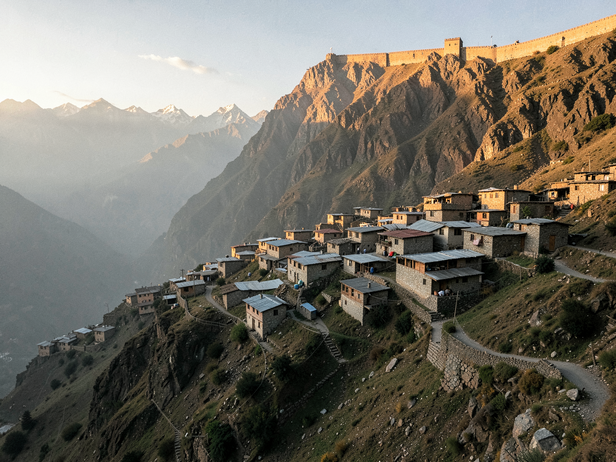
![Himalayan Village at Dusk]()
Himalayan Village at Dusk
Image credit : AI
I'm in a remote Himalayan village, experiencing the thin air haze. Acclimatisation is key at this altitude.
Leh, Spiti and Tawang are not the same problem
Leh is the most visited and the most medically prepared. The city has a district hospital, a hyperbaric chamber at the SNM Hospital, and enough altitude-experienced doctors that a tourist in genuine distress has somewhere to go. The danger in Leh is not the lack of resources. It is the confidence that comes with a comfortable hotel room, which makes it easy to ignore what the body is saying and head out to Khardung La on day two.
Spiti is different in character. Most travellers arrive via the Manali-Kaza road, which means a continuous climb over two days with no single dramatic altitude gain. This can create a false sense of security. The villages of Kibber, Langza and Komic sit between 4,200 and 4,587 metres. There is no hospital in Kaza that handles serious altitude emergencies. The nearest facility with any real capacity is hours away on a road that closes without notice. This is not a reason to avoid Spiti. It is a reason to treat the first two days there as non-negotiable rest, regardless of how well you feel.
Tawang in Arunachal Pradesh sits at roughly 3,048 metres, lower than either Leh or Spiti's upper villages, but it is reached by road from Guwahati via the Sela Pass at 4,170 metres. The descent to Tawang after crossing Sela can make travellers feel they are safe at the lower altitude, while their bodies are still adjusting from the pass. Symptoms that seemed to ease at the pass can reassert themselves in Tawang town, particularly at night.
The symptoms that are not just tiredness
The distinction between expected mild AMS and the early signs of something that requires action is specific and learnable. A headache alone, even a bad one, is not an emergency. A headache that does not respond to a litre of water and a standard dose of paracetamol after two hours is a signal to pay closer attention.
The symptoms that move beyond mild AMS and into territory that warrants immediate descent or medical attention are: ataxia, which is the loss of coordination tested by walking heel-to-toe in a straight line; confusion or unusual irritability that the person themselves may not notice; a persistent dry cough that becomes productive or frothy; breathlessness at rest, not just on exertion; and vomiting that prevents keeping fluids down. These are the presentations associated with High Altitude Cerebral Oedema and High Altitude Pulmonary Oedema, both of which can progress within hours. The treatment for both, in the field, is descent. Not rest, not medication alone. Descent.
Acetazolamide, sold as Diamox, is sometimes recommended as a prophylactic. It works by stimulating faster breathing, which helps the blood absorb more oxygen. Whether to take it, at what dose, and whether it suits a given person's medical history is a conversation for a doctor before the trip, not a decision made at the bus stand in Kaza. Some travellers cannot take it. Some find the side effects, which include tingling in the hands and feet and increased urination, more disruptive than mild AMS itself.
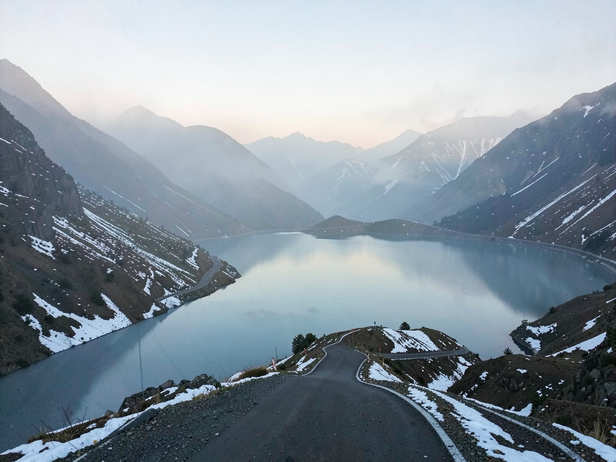
![Sela Pass Mist and Mountains]()
Sela Pass Mist and Mountains
Image credit : AI
I navigate the Sela Pass, a high mountain road disappearing into mist. The cold morning light reveals snow-dusted verges and a serene glacial lake, a stark reminder of the altitude.
What the first forty-eight hours should actually look like
In Leh: arrive, eat something light, drink water, sleep. Do not book a taxi to Pangong on arrival day. The standard advice from the district health department is to spend the first full day at town altitude before moving higher. This is not overcaution. It is the minimum the body needs.
In Spiti: if you drove from Manali, you have already been at altitude for a day. Kaza at 3,800 metres is not the ceiling. Treat your first day in Kaza as a base day. Walk the market. Sit in the sun. Do not drive to Kibber or Langza until the second morning, and only then if you have had no symptoms overnight.
In Tawang: the crossing of Sela Pass is the hardest part physiologically. Stop briefly at the pass, do not linger. Once in Tawang, the first afternoon is for the monastery if you feel well, and for the hotel room if you do not. The town is small enough that you will see everything you came to see in two full days. There is no need to compress it into one.
Hydration matters more than most travellers expect. Alcohol dehydrates and suppresses the breathing response to low oxygen. Both are problems at altitude. The first night is not the night for the local chang.
When to stop being stoic
Indian travellers in particular, and this is a pattern that doctors at Leh's SNM Hospital have noted informally, tend to underreport symptoms because they do not want to inconvenience travel companions or feel they are making too much of discomfort. The result is that mild AMS that could have been managed with a rest day becomes something that requires evacuation.
The rule is simple enough to remember: if the headache is getting worse instead of better after twelve hours at the same altitude, tell someone. If any of the serious symptoms listed above appear, the decision to descend should not wait for morning. Altitude sickness does not plateau politely. It moves fast when it moves.
Leh, Spiti and Tawang reward the traveller who arrives with patience built into the itinerary. The landscapes are not going anywhere. The body, pushed past its limit at 4,000 metres with no road out for three hours, has fewer options.