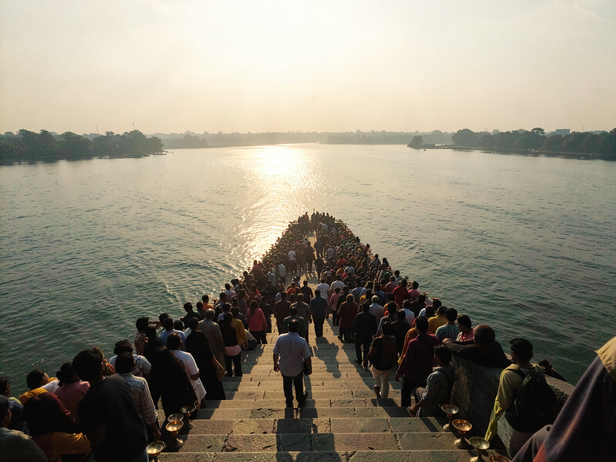
The Gandhi Maidan ghat fills by 3 pm. If you arrive at 4, you are already choosing between a partial view and a dangerous crush. Chhath Puja's Sandhya Arghya, the evening offering to the setting sun, draws lakhs to Patna's Ganga ghats every year, and the logistics of that gathering are as much a part of the experience as the devotion itself.
Which Ghat to Choose
The ghats stretch for roughly 7 kilometres along the Patna waterfront, and they are not equally crowded. Gandhi Ghat, directly behind Gandhi Maidan, is the most photographed and the most packed. If you are there to witness the ritual rather than to move through it, this is where the atmosphere is most complete, brass diyas floating on bamboo rafts, the sinking sun turning the Ganga copper, the collective silence that falls at the exact moment of offering. But the crowd density here between 4:30 pm and 7 pm is not metaphorical. It is structural. People cannot move freely.
Collectorate Ghat, a kilometre east, draws a slightly thinner crowd and gives a cleaner sightline to the river. It is the practical choice for first-time visitors who want to see without being immobilised. Adalat Ghat, further east still, is quieter enough that you can actually walk to the water's edge, though the atmosphere is correspondingly thinner.
Kangan Ghat and the ghats toward Danapur on the western end are primarily neighbourhood ghats, locals only, no tourist infrastructure, but also no tourist crowd. If you have a connection to that area or are willing to arrive very early and stay in one place, the intimacy there is something the central ghats cannot offer.
![River Ghat Evening Devotion]()
River Ghat Evening Devotion
Image credit : AI
I witness the vibrant Chhath Puja evening crowd at Patna ghats, diyas casting a warm glow on the steps.
When to Arrive
The offering to the setting sun happens at sunset, which in mid-November falls between 5:15 pm and 5:30 pm in Patna. Work backward from that. The crowd at Gandhi Ghat is already substantial by 2 pm. By 3:30 pm, the main approach roads, Ashok Raj Path along the riverfront and the lanes feeding down from Fraser Road, are slow. By 5 pm, they are stopped.
Arrive by 1:30 pm if you want a position with a clear view of the water at Gandhi Ghat. This is not an exaggeration for effect. Families of devotees have been in place since before dawn for the morning Arghya; the evening crowd layers on top of them. If 1:30 pm is not realistic, go to Collectorate Ghat and aim for 3 pm.
The hour immediately after sunset, roughly 5:30 pm to 6:30 pm, is when the crowd is at its most static. Everyone has just offered and no one has left. This is also, paradoxically, the most beautiful hour: the diyas are lit, the chanting is continuous, the sky goes from orange to deep blue. Stay if you are in a safe position. Do not try to move through the main crowd during this window.
How to Leave
The exit is the part most visitors do not plan, and it is where things go wrong. The roads feeding the riverfront ghats are single-direction during Arghya evening, the administration typically runs a one-way system pushing vehicles away from the water, but the foot traffic moves in all directions at once once the offering ends.
Identify your exit before you go in. The lanes running north from the riverfront toward Patna Junction are narrower but clear faster than Ashok Raj Path, which becomes a parking lot of autos and tempos trying to move at the same moment. If you came by auto, agree on a pickup point away from the ghat, a named landmark two streets back, before you part ways with the driver. Do not expect to call one from the ghat itself; the network is usually overloaded.
Walking east along the riverfront toward Collectorate Ghat after the offering, then exiting via Exhibition Road, is the route that consistently moves faster than trying to push back through Gandhi Maidan. It adds fifteen minutes of walking but subtracts an hour of standing still.
If you are with children or elderly family members, the exit plan is not optional logistics, it is the main thing to settle before you arrive.
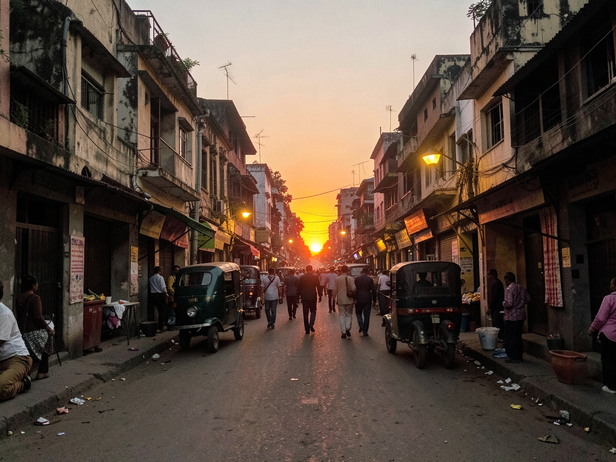
![Dusk Dispersal in Old India]()
Dusk Dispersal in Old India
Image credit : AI
People disperse at dusk in an old Indian city, heading towards the horizon. I observe the evening Arghya Patna preparations.
What to Carry and What to Leave Behind
A small backpack, water, and a phone with offline maps downloaded. Nothing else that you cannot afford to have pressed, jostled, or wet. The ghats are crowded enough that a large bag becomes a hazard to the people around you. The ground near the water is wet and sometimes muddy; sandals you can wash are better than shoes you cannot.
Photography is everywhere and largely welcomed, but the moment of Arghya itself, when devotees stand in the water with the offering basket raised, is a moment of genuine religious concentration. Read the space. A long lens from a respectful distance is different from pushing to the front of the water's edge with a phone.
The Chhath Puja administration in Patna publishes ghat-specific guidelines each year through the district magistrate's office, and local newspapers carry updated crowd management advisories in the days before. Check them. The route plan that worked two years ago may have changed.