R.K. Narayan never gave Malgudi a map reference, and that was the point. The town existed precisely because it could not be pinned down, a composite drawn from Mysore, from Bangalore's older quarters, from the kind of South Indian railway town that smells of filter coffee and diesel and has a silk merchant two doors from the post office. But the 1986 Doordarshan serial made the question unavoidable: where, exactly, was this?
The Railway Station That Became Malgudi Junction
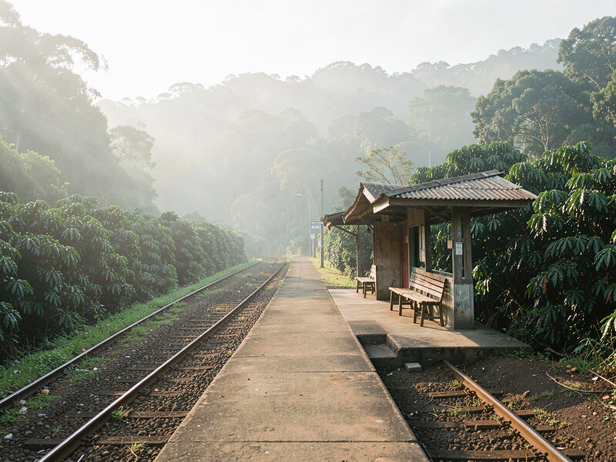
The production team for the Shankar Nag-directed serial chose Arasalu, a small station on the Hassan-Mangaluru line in Karnataka, as the filming location for Malgudi's railway set pieces. The station had what the story needed: a colonial-era platform, a modest waiting room with wooden benches, a goods shed, and the particular quality of stillness that descends on a rural junction between trains. Arasalu is not a scheduled tourist stop. It sits between Sakleshpur and Yedakumeri in the Western Ghats foothills, accessible by train but not by any road that makes it easy. The journey itself, the Hassan-Mangaluru line is one of the most scenic rail routes in India, threading through coffee estates and dense forest, is the reason to go. The station appears briefly and then the ghats swallow the train again.
![Misty Western Ghats Railway]()
Misty Western Ghats Railway
Image credit : AI
A quiet platform in the Malgudi Days filming location, Karnataka, bathed in soft morning light.
Agumbe and the Monsoon That Narayan Wrote
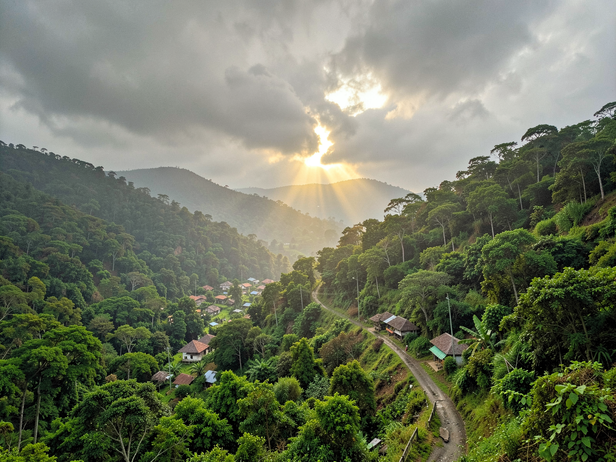
Several outdoor sequences for the serial were shot around Agumbe, a village in the Malnad region of Shivamogga district that receives among the heaviest rainfall on the Indian peninsula, typically between 7,000 and 8,000 mm annually, making it one of the wettest inhabited places in the country. The light in Agumbe in the pre-monsoon weeks, when the air is heavy and the forest canopy turns a specific shade of wet green, is the light that runs through Narayan's prose even when he is describing a dry afternoon. The Doordarshan crew used its topography for the jungle-adjacent scenes. The Agumbe Rainforest Research Station operates here, and the village has a small circuit of guesthouses that fill up in May and June when the rains begin. The best time to visit for the quality of light that matches the serial's visual texture is late September through November, after the peak monsoon but before the mist fully lifts.
Shivamogga and the Town Beneath the Fiction
Shivamogga city itself, administrative headquarters of the district, population just over 300,000, carries the physical grammar of a Malgudi-type town more faithfully than Mysore does, despite Mysore being the city Narayan lived in for most of his life. The older parts of Shivamogga near the bus stand and the market have the right proportion: two-storey buildings with covered walkways, a river nearby (the Tunga, clean enough to swim in at certain ghats), a density of small commerce that has not yet been replaced by malls. There is no Malgudi monument, no heritage walk, no signage pointing to the serial connection. That absence is accurate to the source material.
![Malnad Village Golden Hour]()
Malnad Village Golden Hour
Image credit : AI
I photograph a Malnad village, a potential Malgudi Days filming location, bathed in post-monsoon light.
What the Mysore Connection Actually Gives You
Narayan's house in Mysore, on Vivekananda Road in the Yadavagiri neighbourhood, still stands, privately owned and not open to visitors. The city's older commercial streets, particularly around Devaraja Market and the lanes off Sayyaji Rao Road, carry the street-level texture Narayan was translating into fiction: the stationery shops, the astrologers, the sweetmeat sellers, the particular unhurried pace of a city that has always known it is not Bangalore. The Mysore connection gives you the writer's life. The Karnataka countryside gives you the world he built from it.
Getting There and What to Expect
Shivamogga is roughly five hours from Bengaluru by road and connected by train via the Shivamogga Town station. Sakleshpur, the nearest town of any size to Arasalu station, is about four hours from Bengaluru. The Hassan-Mangaluru rail journey takes around five to six hours end to end and runs daily; the Arasalu stop is a request halt, so confirm with station staff before boarding. Agumbe is about 100 km from Shivamogga by road, roughly two and a half hours through the ghats. Accommodation in Agumbe is basic; Shivamogga has a wider range. October and November are the practical travel window: the rains have eased, the forest is still green, and the light on the ghats in the late afternoon is the closest thing available to the world Narayan described without ever quite locating it.