The moon does not care about your booking confirmation. On Karva Chauth, it rises at a specific time in a specific direction, and if your hill station, your hotel room, or your flight home puts a ridge, a cloud band, or a departure gate between you and it, the fast runs long in a way no spa treatment compensates for. Planning this trip backwards, from moonrise to destination, not from destination to moonrise, changes every decision you make.
Why Moonrise Time Varies More Than People Expect
Moonrise on Karva Chauth is not a single national moment. It varies by latitude, longitude, and local horizon. In 2026, the festival falls on 27 October. At that time of year, moonrise across northern India runs roughly between 8:00 PM and 9:15 PM depending on location, but that half-hour gap matters when you are fasting. Shimla typically sees moonrise around fifteen to twenty minutes later than Delhi on the same night, because the effective horizon is a ridge to the east rather than flat ground. Mussoorie's moonrise is similarly delayed. Coorg, further south, sees it earlier. The Meteorological Department of India and apps drawing on the US Naval Observatory's data give location-specific moonrise times to the minute. Pull the number for your shortlisted destination before you shortlist anything else. That number is the anchor.
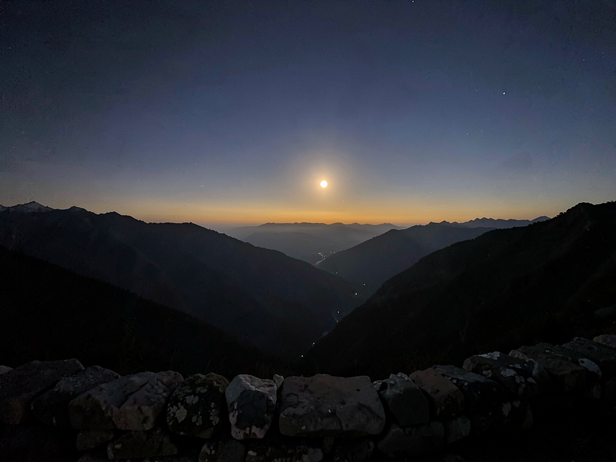
![Himalayan Moonrise Over Valley]()
Himalayan Moonrise Over Valley
Image credit : AI
I'm captivated by the Himalayan moonrise, a perfect backdrop for planning a Karva Chauth 2026 trip.
Choosing the Destination Around the Horizon
A hill station's romance is also its liability on this night. The eastern horizon, the direction from which the moon rises, needs to be open sky, not a forested ridge or a hotel block. Destinations where this works well are those with a valley opening to the east or a ridge-top position with a long sightline. Lansdowne in Uttarakhand sits on a ridge with an open eastern drop into the Garhwal foothills; moonrise there is unobstructed and earlier than at Mussoorie, which sits with Lal Tibba blocking parts of the eastern view depending on where you stand. Kasauli in Himachal Pradesh has a relatively open eastern face from its upper cantonment roads. Coorg's Madikeri has a clear eastern horizon from the fort area and benefits from an earlier moonrise than most northern options. The question to ask any hotel before booking: from your east-facing rooms or terrace, what is the horizon? A flat skyline answer is good. A treeline or ridge answer needs a follow-up: at what elevation does the ridge sit, and does the moon clear it within twenty minutes of the official moonrise time?
The Room and the Terrace Are Not the Same Thing
A hotel with an east-facing terrace is not the same as a hotel room with an east-facing window. Confirm both. Many hill properties have a communal viewing terrace that is genuinely open but a room allocation system that puts late-booking guests on the west side of the building. Book the specific room category, not just the property, and confirm in writing that the room has an unobstructed eastern view. If the property cannot guarantee the room, book the property for the terrace access and accept that you will be watching the moon from a shared space. That is still better than watching it from a west-facing window with binoculars. Some properties in Mussoorie, Nainital, and Dalhousie now market Karva Chauth moonrise packages explicitly, these usually include a terrace reservation, a post-fast meal, and sometimes a puja setup. They cost more, but the eastern view is contractually yours.
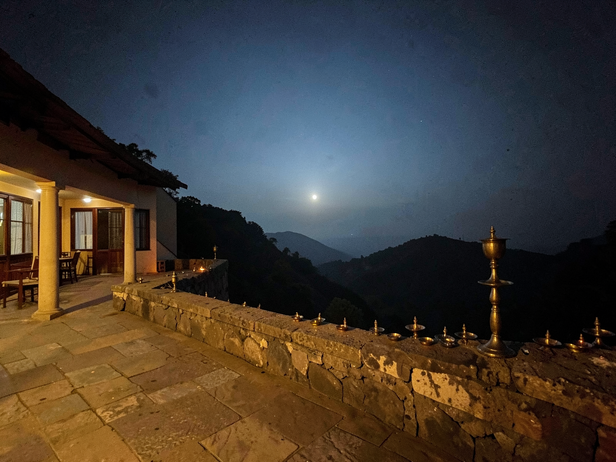
![Moonlit Hill Station Terrace]()
Moonlit Hill Station Terrace
Image credit : AI
A serene hill station terrace awaits the moonrise, perfect for Karva Chauth 2026 trip planning.
The Return Flight Problem
The flight home is where Karva Chauth travel most commonly goes wrong. A 9 PM moonrise means the fast breaks between 9:15 and 9:30 PM after the ritual. A flight departing at 9:45 PM from a hill station's nearest airport, Jolly Grant for Mussoorie, Gaggal for Dharamshala, Mangalore for Coorg, means you are either breaking the fast in an airport security queue or you are missing the flight. The only workable options are a late-night departure of 11 PM or later, an early-morning departure the following day, or a train that leaves after 10:30 PM. For destinations served by road only, the drive back to Delhi from Mussoorie or Lansdowne takes five to six hours on a post-festival night with traffic; leaving before moonrise to catch a late Delhi flight defeats the entire point. The cleanest structure is two nights: arrive the day before, observe the moonrise at the destination, leave the morning after. A single-night turnaround with a same-day return flight is a gamble on weather, traffic, and a moon that will not negotiate.