
Official Vande Mataram Protocol: 6 Stanzas, 3 Min 10 Sec, Must Be Sung Before National Anthem
Nidhi | Feb 14, 2026, 22:10 IST

Trinamool, CPI-M criticise Centre over full-version Vande Mataram directive
Image credit : IANS
The Government of India’s Ministry of Home Affairs has issued a formal protocol for Vande Mataram, defining the official version with all six stanzas (approx. 3 min 10 sec) and directing it must be sung or played before the National Anthem at official functions, educational institutions, flag ceremonies and public events.
The Union Ministry of Home Affairs (MHA) has issued a detailed and first-of-its-kind protocol for the rendition of Vande Mataram, India’s National Song, setting clear rules on how, when, and in what order it should be sung at official functions and public events across the country.
According to the official order dated 28 January 2026, the song - written by Bankim Chandra Chatterjee must be performed in its complete six-stanza form, with a total duration of approximately 3 minutes and 10 seconds.
This marks a departure from long-standing practice where only the first two stanzas were commonly sung at public gatherings. The full six stanzas reflect the complete original composition, restoring the song’s historic structure.![Centre issues detailed protocol for Vande Mataram, now a must for all govt events]() The official guidelines specify that when Vande Mataram is performed along with the National Anthem (Jana Gana Mana), the National Song must be sung or played first. This establishes a clear precedence in protocol for official ceremonies.
The official guidelines specify that when Vande Mataram is performed along with the National Anthem (Jana Gana Mana), the National Song must be sung or played first. This establishes a clear precedence in protocol for official ceremonies.
At all events where the National Song is to be performed, the six-stanza version must be used. The MHA’s directive emphasises uniformity and dignity in how Vande Mataram is observed.
Audience members are required to stand at attention whenever the full official version of Vande Mataram is being sung or played, except in specific exceptions such as when it is part of a film, documentary, or newsreel where standing might disrupt proceedings. The new protocol is intended for a wide range of official and public occasions, including:
The MHA’s move to formalise a protocol for Vande Mataram underscores the government’s intent to honour the National Song with structured decorum similar to other national symbols like the National Flag and National Anthem.
The decision comes as India marks 150 years of the song’s composition, highlighting its historical and cultural importance in the freedom movement and national identity.
By mandating the full version and a standard order of performance, the government aims to promote uniformity, respect, and patriotic sentiment, particularly among younger generations in educational settings.Vande Mataram was written in the late 19th century and became a rallying cry during India’s struggle for independence. It was adopted as the National Song of India in 1950, recognised for its patriotic resonance and historical significance, though it is distinct from the National Anthem (Jana Gana Mana) which holds constitutional status.
Over decades, debates around how and which parts of the song should be sung have shaped its public observance. The new protocol now provides official clarity on these aspects.
According to the official order dated 28 January 2026, the song - written by Bankim Chandra Chatterjee must be performed in its complete six-stanza form, with a total duration of approximately 3 minutes and 10 seconds.
This marks a departure from long-standing practice where only the first two stanzas were commonly sung at public gatherings. The full six stanzas reflect the complete original composition, restoring the song’s historic structure.
Key Elements of the New Protocol
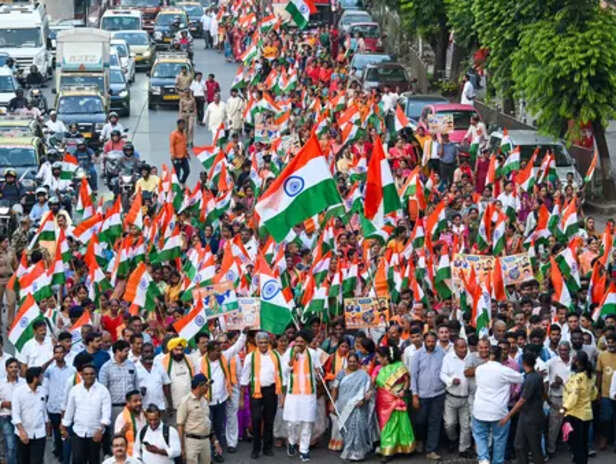
Centre issues detailed protocol for Vande Mataram, now a must for all govt events
Image credit : IANS
1. Order of Performance
2. Full Version Mandatory
3. Standing Required
Where and When It Applies
- Flag unfurling ceremonies and cultural events.
- Civil investiture events and formal functions.
- Arrival and departure of the President, Governors or Lieutenant Governors at state events.
- Broadcasts immediately before and after the President addresses the nation on All India Radio or television.
- Government and public events where national symbols are honoured.
- Educational institutions, with schools encouraged to incorporate mass singing of the song in assemblies and institutional functions.
Purpose and Significance
The decision comes as India marks 150 years of the song’s composition, highlighting its historical and cultural importance in the freedom movement and national identity.
By mandating the full version and a standard order of performance, the government aims to promote uniformity, respect, and patriotic sentiment, particularly among younger generations in educational settings.
Background on Vande Mataram (Context)
Over decades, debates around how and which parts of the song should be sung have shaped its public observance. The new protocol now provides official clarity on these aspects.