
Why the Brain Remembers Embarrassment Better Than Success
Kazi Nasir | Jan 05, 2026, 13:24 IST

Why The Brain Remembers Embarrassment
Image credit : Freepik
Why do embarrassing memories stay vivid for years while praise and success fade so quickly? This article explores the psychology behind why the human brain remembers embarrassment more strongly than achievement. Drawing on insights from Rick Hanson’s negativity bias theory and Daniel Kahneman’s work on loss aversion, it explains how the brain evolved to prioritize social threats over rewards.
Highlights
- Explains why embarrassing memories last longer than success
- Connects neuroscience with everyday emotional experiences
- Uses Rick Hanson’s negativity bias to explain threat memory
- Applies Daniel Kahneman’s loss aversion theory to emotions
You may forget the admiration or praise you received last month, but you can still remember those awkward words that made you feel stupid in front of everyone ten years ago. The sound of laughter, the staring of eyes made you wise that the floor should open beneath you. Do these qualities make humans ungrateful? Who knows. But this is not because humans are weak, dramatic or overly sensitive. This is how the brain is supposed to function and it's doing exactly what it was designed to do. So, why does embarrassment cling to memory with such force, while success fades so quickly?
![Embarrassment vs Success Memory]()
Rick Hanson, an American psychologist try to explain the phenomenon with evolutionary reasons. He famously described the brain as being like "Velcro for negative experiences and Teflon for positive ones." According to him, the brain has a negativity bias. The human mind evolved to remember threats more than rewards becasue in early human life, forgetting a danger could be fatal (“Don’t do this again," “This behaviour puts you at risk,” “Remember this so you survive next time.”) but forgetting success was not.
Nobel laureate and psychologist Daniel Kahneman showed why losses feel stronger than gains. He explains the behavioural psychology as humans are problem solvers, the brain overvalues mistakes to demand correction. While success feels normal once achieved.
Both thinkers, Rick Hanson and Kahneman, tried to address the phenomenon of why the brain remembers embarrassment better than success. Hanson explains why the brain stores embarrassment, while Kahneman explains how strongly it feels compared to success.
![Why Embarrassing Memories Last Longer]()
Becasue it threatens the social belonging of an entity named human. Our brain takes note of mistakes for problem-solving and replay later. Success make human feels safe and therefore it becomes unurgent. Emotional intensity strengthens memory storage and our mind also confuses self-awareness with self-attack.
So from next time you encounter any embarrassing memory, don't forget to remember that it's not resurfacing to punish you, rather it's resurfacing becasue your brain believes it is protecting you.
Explore the latest trends and tips in Health & Fitness, Spiritual, Travel, Life Hacks, Trending, Fashion & Beauty, and Relationships at Times Life!
Q1. Why does my brain keep replaying cringe memories?
Ans: Strong emotional reactions are more memorable.
Q2. Why do we remember negative more than positive?
Ans: Becasue we humans are problem solvers.
Q3. Is it true that 80% of our thoughts are negative?
Ans: 80% of our thoughts are negative and 95% of our thoughts are repetitive, according to the National Science Foundation.
The Brain Is Wired to Protect, Not to Praise
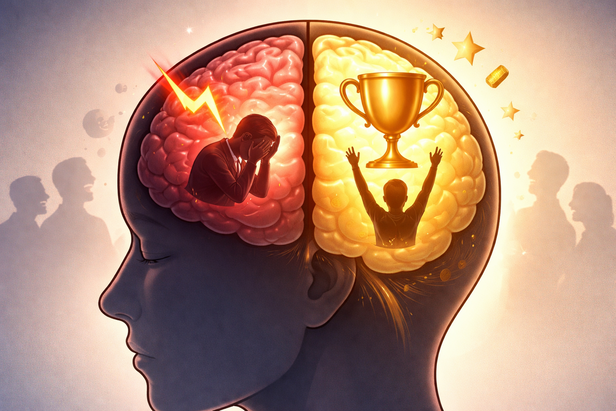
Embarrassment vs Success Memory
Image credit : AI - ChatGPT
Rick Hanson, an American psychologist try to explain the phenomenon with evolutionary reasons. He famously described the brain as being like "Velcro for negative experiences and Teflon for positive ones." According to him, the brain has a negativity bias. The human mind evolved to remember threats more than rewards becasue in early human life, forgetting a danger could be fatal (“Don’t do this again," “This behaviour puts you at risk,” “Remember this so you survive next time.”) but forgetting success was not.
Why Success Feels Quiet While Embarrassment Shouts
Nobel laureate and psychologist Daniel Kahneman showed why losses feel stronger than gains. He explains the behavioural psychology as humans are problem solvers, the brain overvalues mistakes to demand correction. While success feels normal once achieved.
Both thinkers, Rick Hanson and Kahneman, tried to address the phenomenon of why the brain remembers embarrassment better than success. Hanson explains why the brain stores embarrassment, while Kahneman explains how strongly it feels compared to success.
Why Embarrassment Lasts Longer

Why Embarrassing Memories Last Longer
Image credit : Freepik
Becasue it threatens the social belonging of an entity named human. Our brain takes note of mistakes for problem-solving and replay later. Success make human feels safe and therefore it becomes unurgent. Emotional intensity strengthens memory storage and our mind also confuses self-awareness with self-attack.
So from next time you encounter any embarrassing memory, don't forget to remember that it's not resurfacing to punish you, rather it's resurfacing becasue your brain believes it is protecting you.
Explore the latest trends and tips in Health & Fitness, Spiritual, Travel, Life Hacks, Trending, Fashion & Beauty, and Relationships at Times Life!
FAQs
Ans: Strong emotional reactions are more memorable.
Q2. Why do we remember negative more than positive?
Ans: Becasue we humans are problem solvers.
Q3. Is it true that 80% of our thoughts are negative?
Ans: 80% of our thoughts are negative and 95% of our thoughts are repetitive, according to the National Science Foundation.