Death is an ultimate reality of human existence. Any living thing that has taken birth in this world will experience it. Therefore, instead of suppressing the thoughts related to death, we should attempt to understand it. With greater understanding, we will be able to deal with it gracefully and peacefully. In fact, Lord Krishna has provided some timeless pieces of wisdom related to death in Bhagavad Gita. Lets explore what this sacred and profound text teaches us about death.
1. Accept the Truth of Death
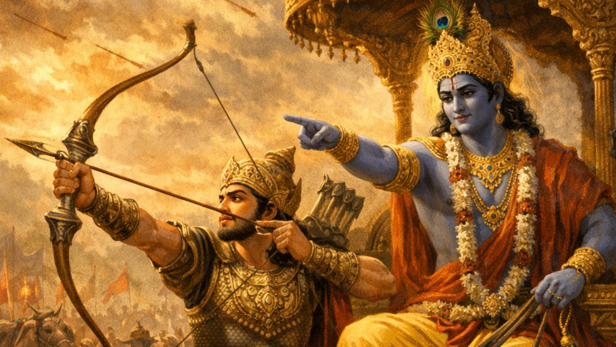
![Lord Krishna on the Universal Law of Impermanence (Image Credit: AI)]()
Lord Krishna on the Universal Law of Impermanence (Image Credit: AI)
In the second chapter of Gita, Lord Krishna says:
"jātasya hi dhruvo mṛtyur dhruvaṁ janma mṛtasya ca |
tasmād aparihārye ’rthe na tvaṁ śocitum arhasi ||”
Translation: "For one who has been born, death is certain, and for one who has died, birth is certain. Hence, in an inevitable situation, you should not lament.”
The first step towards understanding death is to accept its universal nature. Whether we like it not, everything in this world is impermanent. Whether it is our emotions, friends, pets or even the earth that we reside in; each and everything will get old and wither away. Therefore, instead of becoming emotional or nihilistic about this truth, we should become active and fulfil our duties with utmost sincerity.
Each and every second that is passing is taking us closer to death. So, we don’t have even a single moment to waste on mindless distractions and meaningless sensual gratifications. Focus on your duty. Work without attachments. This is the path of Karma Yoga and liberation from the eternal cycle of birth and death.
2. Eternal Nature of Atman or Self
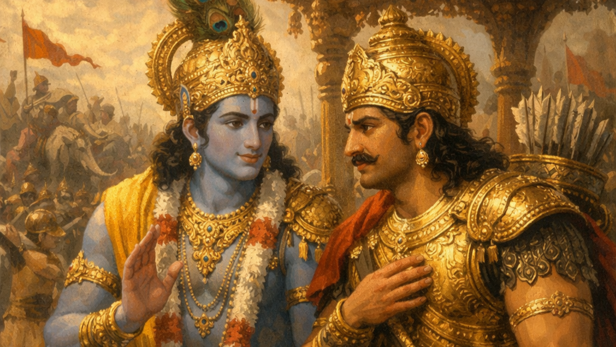
![Lord Krishna Advising Arjuna (Image Credit: AI)]()
Lord Krishna Advising Arjuna (Image Credit: AI)
Verse 20 of second chapter also alludes to death. Lord Krishna says:
”na jāyate mriyate vā kadācin nāyaṁ bhūtvā bhavitā vā na bhūyaḥ |
ajo nityaḥ śāśvato ’yaṁ purāṇo na hanyate hanyamāne śarīre ||"
Translation: “This soul never takes birth and never dies at any time nor does it come into being again when the body is created. The soul is birth-less, eternal, imperishable and timeless and is never destroyed when the body is destroyed.”
Even though the body and the subconscious beliefs and perspectives that we hold within ourselves will perish with the passage of time, the eternal truth of Godly essence will remain as it is, forever. The immortal, omnipresent, omniscient and unchanging truth of Atman is present within all of us. Even after the moment of death, Atman will remain the same. Thus, we must realise the fact that it is just our body that is passing away. Our inner essence or connection with the Supreme will remain the same.
3. Internalising the Truth of Oneness
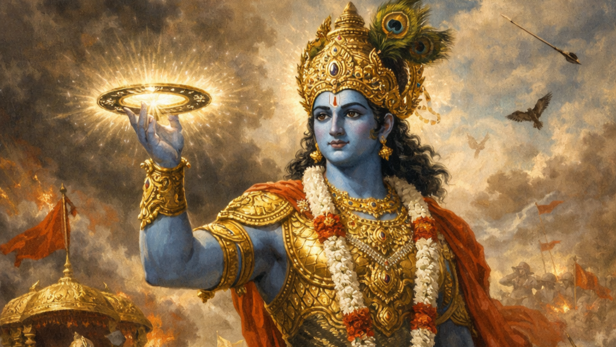
![Lord Krishna During the Mahabharata War (Image Credit: AI)]()
Lord Krishna During the Mahabharata War (Image Credit: AI)
In chapter 2 itself Lord Krishna says:
"nainaṁ chindanti śastrāṇi nainaṁ dahati pāvakaḥ |
na cainaṁ kledayanty āpo na śoṣayati mārutaḥ ||”
Translation: “This soul cannot be pierced by weapons, burned by fire, moistened by water, or withered by the wind.”
Manifesting the realisation of oneness with our eternal Self at an experiential level leads to Moksha. To experience this ultimate oneness, Gita tells to engage in Karma Yoga i.e., fulfil your purpose in life without expecting anything in return. This is the path towards deep inner purification.
Secondly, we should constantly contemplate the truth of divine presence in all beings. When we begin to engage in this thought consistently, a profound feeling of equality will manifest in our hearts. We will experience the great truth that no one is above or below another living being. The same Godly essence is working within all of us. Then, through meditation and yogic exercises, we have to attain absolute control over our senses.
In short, by understanding death, by preparing for it and by engaging in Karma Yoga while we move towards it, we can ensure that the doors of Moksha will remain open in front of us.
Explore the latest trends and tips in
Health & Fitness,
Spiritual,
Travel,
Life Hacks,
Trending,
Fashion & Beauty, and
Relationships at
Times Life!